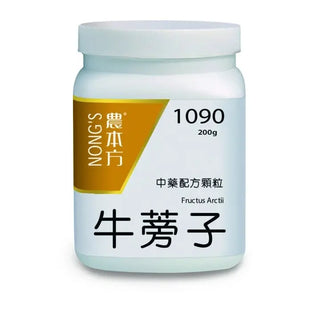
Fruits and seedsExterior-releasingFructus Arctii

Niu Bang Zi (Burdock Seed / Arctium Fruit)

A practical guide to Niu Bang Zi: what it is, how Traditional Chinese Medicine uses it, the classical formulas it appears in, and who should be careful with it.

View Herb Profile →

Last reviewed Oct 13, 2026

Quick Facts

Latin NameFructus Arctii
Chinese Name & Pinyin 牛蒡子 · Niu Bang Zi
Medicinal PartFruits and seeds
The herbNiu Bang Zi is the dried fruit of Arctium lappa, a ridged achene. Burdock root is food. Crush it.
Nature and channelsAcrid, bitter, cold. Enters the Lung and Stomach. Acridity disperses wind-heat. Bitter cold resolves toxin and eases the throat. It can also slip the intestines.
Pharmacopoeia lineDisperses wind-heat. Diffuses the Lung and vents rashes. Resolves toxin and eases the throat. Used for wind-heat common cold, cough with much sputum, measles, wind-rash, swollen sore throat, mumps, erysipelas, and sores.
Pattern cuesWind-heat sore throat. Cough with sputum. A rash that will not vent. Mumps. Abscesses.
In this articleFruit versus root. Niu Bang Zi versus Bo He, Jing Jie, and Ban Lan Gen. Why it is crushed. Why loose stools are a stop sign. Who should skip it.

What Is Niu Bang Zi?

Niu Bang Zi (牛蒡子; Niú Bàng Zǐ; Latin: Arctii Fructus; English: great burdock fruit) is the dried ripe fruit of Arctium lappa L. In Chinese medicine it is a cool, acrid exterior-releasing herb. It is acrid, bitter, and cold, enters the Lung and Stomach channels, and its core actions are to disperse wind-heat, diffuse the Lung and vent rashes, and resolve toxin and ease the throat. It is not burdock root. The root is food (gobo). The official item for releasing the exterior and easing the throat is the seed-like fruit. In a decoction it should be crushed. It is not Bo He. Mint is light and aromatic. Niu Bang Zi is bitter-draining and slippery. It can also unblock the bowel, ease the throat, and reduce swelling. Wind-cold common cold and spleen-deficiency loose stools are a poor match.

It is used most often for three patterns:

  • Wind-heat common cold — cough with much sputum, swollen sore throat
  • Measles or wind-rash that will not vent
  • Mumps, erysipelas, abscesses and sores

The usual decoction dose is 6–12 g. Qi deficiency with loose stools, and too much opening and draining, are cautions. Acrid, bitter, and cold, it is not a daily “throat burdock tea.” Diffusing when there is no wind-heat injures the middle.

When wind-heat congests the Lung, or heat-toxin binds in the throat and cheeks, sore throat, phlegm cough, and a rash that will not come through are common. Niu Bang Zi is acrid, bitter, and cold. It disperses, diffuses, and slips downward, which is why it appears in Yin Qiao San. It slips and drains more than it holds. A cold abdomen and loose stools loosen further if more cold is added.

Niu Bang Zi is not a catch-all throat or rash seed. In wind-cold at the exterior or spleen-deficiency diarrhea, using it alone can cool and slip the bowel. Whether it belongs in a Yin Qiao San–type formula should be decided by a licensed Chinese medicine practitioner after pattern diagnosis.

Niu Bang Zi Arctium Fruit

Niu Bang Zi: Materia Medica Profile

Identification & Quality Standard

Fructus Arctii

Botanical Origin

The dried mature fruit of Arctium lappa L.(Asteraceae)

Production Regions

Primarily produced in the Chinese provinces of Hebei, Jilin, Liaoning, Zhejiang, Heilongjiang.

Quality Requirements

Superior medicinal material is large, full, grayish-brown.

Macroscopic Features

Inverse oval shape, slightly flat, and curved, 5~7mm long, 2~3mm wide. Externally grayish-brown, with purple black spots, with numerous longitudinal ridges, often has 1~2 obvious ridges in the middle. Apex is blunt round, slightly wide, with round ring, center has spotted remnants of style; base is slightly narrow on the relatively pale side. Fruit skin is relatively hard, 2 cotyledons, pale yellowish-white, oily. faint odor, bitter and then slightly acrid and numbing to the tongue.

3 Authentic Producing Areas and Quality Identification

While it grows in provinces like Hebei, Jilin, Liaoning, and Zhejiang, the quality depends heavily on how it is processed and stored.

  • Appearance: Good quality raw seeds are grayish-brown, hard, slightly flattened, and oval-shaped with an oily interior. They smell slightly bitter and pungent.
  • Stir-fried Version: These seeds are slightly puffed, darker in color, crispier, and have a roasted fragrance.
  • Look-alikes: It can be confused with other seeds from the same plant family, but the fakes usually lack the distinct oily texture and spicy-aromatic smell of genuine Niu Bang Zi.

Traditional Properties & Historical Lineage

Nature, Flavour & Channel Tropism

Acrid, Bitter; ColdLungStomach

1. 2 Historical Herbal Records

Throughout history, classic TCM texts have praised its detoxifying abilities:

  • Shen Nong Ben Cao Jing noted it could clear wind and brighten the eyes.
  • Xin Xiu Ben Cao mentioned it removes "bad wind."
  • Ben Cao Gang Mu highlighted its famous ability to clear rash toxins, soothe the throat, and keep the bowels moving.
  • De Pei Ben Cao confirmed it is great for sore throats and skin sores.

2. 3 Evolution of Medicinal Understanding

TCM doctors have historically used this herb flexibly. Some focus on its ability to soothe a severely sore throat caused by wind-heat, while others rely on it to help stubborn rashes break through the skin. However, historical practitioners also frequently warned about its cold nature—reminding us that people with a weak, cold digestive system (Spleen/Stomach) should use it very carefully so they don't damage their digestive fire.

Niu Bang Zi Arctium Fruit

Core Efficacies & Traditional Applications

Traditional Functions

Dispels wind heat, diffuses lung and outthrusts rashes, resolves toxin and benefits throat. Apply to wind-heat type common cold, cough with phlegm, measles and rashes, throat swelling and pain, mumps erysipelas, abscess and sore swelling and toxin.

1. 1 Primary Use: Clearing and Dispersing Wind-Heat

Traditionally, Niu Bang Zi (Burdock Seed) is highly valued for clearing "wind-heat" pathogens from the body.

  • Signs you might need it: Symptoms of a wind-heat cold, such as fever, mild chills, headache, sore throat, coughing up yellow phlegm, and dry mouth.
  • Common Pairings:
    • To boost its wind-heat dispersing power: Paired with herbs like Bo He (Peppermint) and Jing Jie (Schizonepeta).
    • To specifically target a severely sore throat: Paired with Jie Geng (Platycodon) and Gan Cao (Licorice Root).
  • When to Avoid: Do not use this if you have a "wind-cold" cold (severe chills, mild fever, clear runny nose, white/clear phlegm) or if you have a weak, cold digestive system (frequent stomachaches, diarrhea, cold hands and feet).

2. 2 Secondary Use: Venting the Lungs and Erupting Rashes

Another classic use is helping the lungs push out toxins, specifically when skin rashes (like measles or rubella) are struggling to break through the skin during the early stages of an illness.

  • Signs you might need it: Rashes that won't fully erupt, accompanied by fever, cough, and throat discomfort.
  • Common Pairings: Often used with Chan Tui (Cicada Slough) and Bo He (Peppermint) to help the rash vent properly so the heat doesn't stay trapped inside the body.
  • When to Avoid: Do not use if the rash has already fully broken out, or if the failure to erupt is due to extreme weakness (Qi or Blood deficiency, showing up as severe fatigue and a pale face).

3. 3 Classic Herb Pairing: Niu Bang Zi and Bo He

A very common combination in TCM is pairing Niu Bang Zi with Bo He (Peppermint).

  • How they work together: Niu Bang Zi is excellent at draining heat from the lungs and stomach, venting rashes, and clearing toxins. Meanwhile, Bo He excels at dispersing wind-heat in the upper body and clearing the head and eyes.
  • The Synergy: Together, they create a powerful tag-team for soothing wind-heat sore throats and early-stage rashes. However, because both are cooling and dispersing herbs, people with a weak stomach should only use this combo under a doctor's guidance.

Niu Bang Zi Arctium Fruit

Modern Research

Modern research offers useful context, but Traditional Chinese Medicine prescribes on whole-pattern diagnosis rather than isolated compounds.

(Note: Modern science offers interesting insights, but these do not replace traditional medical advice.)

1. 1 Main Chemical Components

Lab tests show that Niu Bang Zi contains lignans (most notably arctiin), small amounts of volatile oils, flavonoids, and fatty acids.

  • In the Lab: Arctiin has shown some ability to inhibit common respiratory bacteria in test tubes.
  • Animal Studies: Certain extracts helped reduce fever in animals. However, we still lack direct human clinical trials to confirm exactly how well it reduces fever in people.

2. 2 Modern Pharmacological Research Directions

Today, researchers are mainly looking into its anti-inflammatory and antibacterial potential.

  • Test-tube studies suggest the lignans might help regulate inflammatory cells.
  • Animal studies show it may reduce inflammation in the respiratory tract.
  • Despite these promising signs, research is still in its basic stages.

3. 3 Limitations of Modern Research

When reading about modern studies on Niu Bang Zi, keep these four things in mind:

  • Lab vs. Human: What works in a test tube or a mouse does not automatically work the same way in a human body.
  • Extracts vs. Whole Herbs: Modern labs use highly concentrated, single-chemical extracts. This is completely different from drinking a traditional, gently boiled herbal tea.
  • Inconsistent Methods: Different labs use different extraction methods and doses, making it hard to draw one unified conclusion.
  • Holistic Synergy: TCM relies on the whole herb working together. Judging Niu Bang Zi based on just one chemical compound completely misses the big picture of how the whole plant interacts with the body.

Niu Bang Zi Arctium Fruit

Comparing Similar Herbs

1. 2 Similarities Between Niu Bang Zi and Bo He

Because they are so often used together, it is helpful to look at what they share:

  • Both primarily disperse wind-heat to relieve early cold symptoms.
  • Both are classic remedies for wind-heat colds and sore throats.
  • Both are frequently used in teas or formulas for venting rashes.
  • Both require caution regarding your body constitution (especially if your digestion is weak).

2. 3 Core Differences

  • Nature & Flavor: Niu Bang Zi is cold, bitter, and pungent (enters the Lung/Stomach meridians). Bo He is cool and pungent (enters the Lung/Liver meridians).
  • Main Strength: Niu Bang Zi excels at clearing heavy heat, soothing severe sore throats, venting rashes, and slightly moving the bowels. Bo He is much better at clearing the head and eyes, and soothing stagnant liver energy (great for headaches or red eyes).
  • Direction of Action: Niu Bang Zi pushes energy downward while dispersing (clearing stomach/lung heat). Bo He pushes energy upward while dispersing (clearing the head).
  • Who Should Avoid It: Avoid Niu Bang Zi if you have a cold stomach and frequent diarrhea. Avoid Bo He if you have a weak constitution and sweat heavily (since it promotes sweating).

3. 4 Summary in One Sentence

Niu Bang Zi is better at draining lung/stomach heat and detoxifying rashes, while Bo He is better at dispersing wind-heat outwards and clearing up headaches and red eyes; though both treat wind-heat colds, they cannot always be swapped.

Niu Bang Zi Arctium Fruit

Classical Formulas Containing Niu Bang Zi

+1 more

Diet & Daily Home Use

1. 1 Home Remedies and Herbal Teas

Here are two gentle, low-risk ways to use this herb at home:

  • Recipe 1: Burdock Seed and Peppermint Tea
    • Ingredients: 3g Niu Bang Zi, 2g Bo He (Peppermint), a little rock sugar.
    • How to make: Rinse the Niu Bang Zi, put it in a cup with boiling water, cover, and steep for 10 minutes. Add the Bo He, steep for 3 more minutes, sweeten with rock sugar, and drink.
    • Best for: The very early stages of a wind-heat cold (mild sore throat, dry mouth, headache).
    • Caution: Not for people with a cold/weak stomach, chronic diarrhea, or heavy sweating. Drink 1-2 times a week maximum.
  • Recipe 2: Burdock Seed Porridge
    • Ingredients: 5g Niu Bang Zi, 50g rice, rock sugar.
    • How to make: Wrap the seeds in a small gauze bag. Boil it with the rice and water to make a porridge. Remove the herbal bag, add rock sugar, and eat.
    • Best for: Mild wind-heat sore throats accompanied by dry stools.
    • Caution: Avoid if you have a cold stomach or diarrhea. Eat at most once every two weeks.

2. 2 Decoction and Processing Differences

  • Raw vs. Stir-fried: Raw Sheng Niu Bang Zi is much colder, making it better for strong wind-heat and severe sore throats. Stir-fried Chao Niu Bang Zi is less cold and crispier, making it safer for people with slightly weaker stomachs.
  • How to Brew: These seeds do not require special boiling instructions (like pre-boiling or bagging) when making a standard herbal decoction.
  • Extracts: Remember that concentrated herbal extracts are much stronger than raw tea ingredients, so the dosages are not interchangeable.

3. 3 Dosage and Duration

  • Standard TCM Dose: Usually 3 to 10 grams, depending on the severity of the illness and your body type.
  • Home/Food Dose: Keep it under 5 grams to avoid overwhelming your system with its cold nature.
  • Duration: Do not use this herb long-term. Stop after 1 week. If you still feel sick, see a doctor.
Niu Bang Zi Arctium Fruit

Contraindications & Safety Warnings

1. 1 Who Should Avoid It

  • Cold/Weak Spleen & Stomach: If you frequently have stomachaches, diarrhea, cold hands/feet, and poor appetite, this cold herb will make it worse.
  • Wind-Cold Colds: If you are shivering, have a clear runny nose, and cough up clear/white phlegm, avoid this herb.
  • Late-Stage Rashes or Weakness: Do not use if a rash has already fully erupted, or if you are extremely pale and fatigued.
  • Pregnant & Nursing Women: There isn't enough safety data, so it is best to avoid it.
  • Kids & Seniors: Their metabolism is weaker; use only under strict doctor supervision.
  • Allergies: If you are allergic to plants in the daisy/aster family, you might react to this herb.

2. 2 Drug Interactions and Dietary Notes

  • Medications: Niu Bang Zi may interact with blood thinners, blood pressure medications, diabetes drugs, and sedatives.
  • Spacing it out: If you are taking Western medications, separate them from herbal teas by at least 1 to 2 hours to prevent absorption issues. Always consult your doctor if you are on prescription meds.

3. 3 Side Effects and Overdose Risks

  • Digestive Upset: Normal doses are generally safe, but taking too much (or having a weak stomach) can cause nausea, vomiting, stomach pain, and diarrhea.
  • Allergies: Some people may develop a skin rash or itchiness.
  • When to See a Doctor: Stop taking it immediately and seek medical help if you experience severe allergic reactions, continuous vomiting, breathing difficulties, or rapid worsening of symptoms. Prolonged use will damage your digestive system's natural warmth (Yang Qi), so strictly limit how long you use it.

Frequently Asked Questions About Niu Bang Zi

What is Niu Bang Zi? Are burdock root, Bo He and Chan Tui the same?
Official Niu Bang Zi (牛蒡子) is the dried mature fruit of Arctium lappa. The pharmacopoeial name is Arctii Fructus. Also called Da Li Zi. Burdock root is the root, often a vegetable—not the medicinal fruit by equal weight. Bo He is acrid-cool: courses wind-heat and clears the head and eyes. Chan Tui is sweet-cold: courses wind-heat, benefits the throat, vents rashes, brightens the eyes and extinguishes wind to stop spasms. Write Niu Bang Zi or fried Niu Bang Zi; crush at use. Use caution in qi vacuity with loose stool.
What are the TCM properties and traditional uses of Niu Bang Zi?
According to the Chinese Pharmacopoeia, Niu Bang Zi is acrid, bitter and cold, enters the Lung and Stomach channels, and acts to course and disperse wind-heat, diffuse the Lung and vent rashes, resolve toxin and benefit the throat. It is used for wind-heat common cold, cough with copious phlegm, measles, wind-rash, swollen painful throat, mumps, erysipelas and welling-abscess toxin. Acrid-bitter-cold and slippery, it suits wind-heat and heat toxin—not qi vacuity with loose stool, or wind-cold without heat.
How do you choose raw versus fried Niu Bang Zi?
Coursing wind-heat, resolving toxin and benefiting the throat more often use the raw fruit. Fried Niu Bang Zi is slightly milder and less slippery, suitable if the gut is weak. Both should be crushed. Externally, decoct as a gargle. Do not treat burdock root or kitchen burdock vegetable as equal-weight Niu Bang Zi.
What is the usual dosage? Can it be drunk daily as a throat-clearing fire tea?
The pharmacopoeial decoction dose is 6–12 g, crushed into the decoction. It is not a four-season “Niu Bang Zi throat tea.” Without heat, cold only loosens the stool further. Wind-heat sore throat and poorly vented rash need a practitioner to name a short course; it does not replace throat and rash assessment.
What are the contraindications? Can it be used in pregnancy?
Use caution in qi vacuity with loose stool. Cold and slippery, it frees the stool; forbid in Spleen-vacuity diarrhea. Pregnancy with wind-heat needs a practitioner to assess a short course; it is not a calm-fetus or daily laxative. Stop if cold epigastric-abdominal pain and loose stool appear. Dyspnea, high fever with convulsions and severe parotid swelling are emergencies.
Can Niu Bang Zi benefit the throat, vent rashes and resolve toxin?
It can help wind-heat and heat toxin attacking upward. Wind-heat common cold joins honeysuckle, Forsythia, mint and Platycodon in Yin Qiao San. Massive head-warmth and mumps join Scutellaria, Coptis, Cimicifuga and Isatis in a Pu Ji Xiao Du Yin type formula. Poorly vented rash joins cicada slough and mint. It courses wind-heat, diffuses the Lung, vents rashes, resolves toxin and benefits the throat—not a specific for every sore throat, every rash or every constipation.
Can Niu Bang Zi be drunk daily as a fire-lowering, laxative or cold-prevention tea?
Wind-heat sore throat and poorly vented rash may enter a short formula; Spleen vacuity with loose stool only grows more draining as it cools. “Niu Bang Zi lowers fire and frees the stool” does not replace infection and bowel assessment. Coursing wind-heat, resolving toxin and benefiting the throat should name Niu Bang Zi 6–12 g, crushed.
How do you choose among Niu Bang Zi, Bo He, Chan Tui, Jie Geng and Ban Lan Gen?
Burdock fruit is acrid-bitter-cold: courses wind-heat, diffuses the Lung, vents rashes, resolves toxin and benefits the throat—also slippery to the intestines. Mint is acrid-cool: courses wind-heat, clears the head and eyes, benefits the throat and vents rashes—light and clear. Cicada slough is sweet-cold: courses wind-heat, benefits the throat, vents rashes, brightens the eyes and extinguishes wind. Platycodon is bitter-acrid-neutral: diffuses the Lung, dispels phlegm, benefits the throat and expels pus. Isatis root is bitter-cold: clears heat, resolves toxin, cools Blood and benefits the throat. Wind-heat sore throat often pairs Niu Bang Zi with Jie Geng and mint; rash with eye screens favors Chan Tui; massive head-warmth heat toxin favors Ban Lan Gen. They may be paired; qi vacuity with loose stool forbids large Niu Bang Zi and Ban Lan Gen.
Which herbs is Niu Bang Zi combined with? What are the representative formulas?
Wind-heat common cold joins honeysuckle, Forsythia, mint and Platycodon in Yin Qiao San. Heat-toxin swollen throat and mumps join Scutellaria, Coptis and Cimicifuga in Pu Ji Xiao Du Yin. Write Niu Bang Zi 6–12 g, crushed at use.
How do you choose and store Niu Bang Zi?
Choose plump fruits that are gray-brown with purplish-black spots, clear longitudinal ridges, oily cotyledons, and a bitter then slightly acrid numbing taste. Hollow, rancid, moldy or moth-eaten lots are discarded. Store airy and dry. Crush at use. Buy pharmacopoeial Niu Bang Zi; do not replace coursing wind-heat, resolving toxin and benefiting the throat with burdock root or an unidentified aster-family achene by equal weight.

Medical Disclaimer — This article is provided for educational purposes only and describes traditional Chinese medicine concepts. It is not medical advice, and it is not intended to diagnose, treat, cure or prevent any disease. Always consult a qualified practitioner before using any herb, particularly if you are pregnant, nursing, taking medication or managing a diagnosed condition.

More Chinese Herbs

Login

Forgot your password?

Don't have an account yet?
Create account

Niu Bang Zi (Arctium Fruit): Disperse Wind-Heat, Benefit the Throat, and Vent Rashes