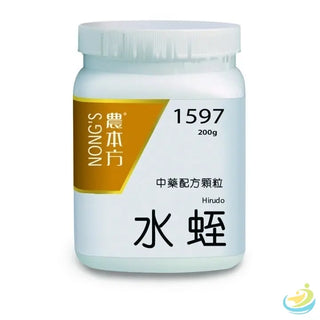
Zoological substancesBlood-activatingHirudo

Shui Zhi (Leech)

A practical guide to Shui Zhi: what it is, how Traditional Chinese Medicine uses it, the classical formulas it appears in, and who should be careful with it.

View Herb Profile →

Last reviewed Oct 28, 2026

Quick Facts

Latin NameHirudo
Chinese Name & Pinyin 水蛭 · Shui Zhi
Medicinal PartZoological substances
The itemShui Zhi is the dried, processed body of the freshwater leech. Meng Chong (tabanus fly) is not this drug.
Nature and channelsSalty, bitter, neutral, mildly toxic. Enters the Liver. Salty bitter neutral breaks stasis, unblocks the channels, disperses masses, and settles the period.
Pharmacopoeia lineBreaks blood stasis and unblocks the channels; disperses masses and settles the period. Used for stasis masses, stopped menses, bruises, and postpartum stasis pain.
Pattern cuesFixed painful lumps. Stopped menses. Dark-clotted flow. Bruises that linger. Postpartum cramping.
In this articleShui Zhi versus Meng Chong. Breaking stasis with force versus supporting the body. Why the dose is small and the course short. Why pregnancy and heavy periods are absolute stops.

What Is Shui Zhi?

Shui Zhi (水蛭; Shuǐ Zhì; Latin: Hirudo; English: leech) is the dried whole body of the freshwater leech — the dark, flat, segmented worm of ponds and rice paddies — gathered in summer and autumn, then processed by blanching or stir-frying for use. It is salty, bitter, and neutral with a mild toxicity, enters the Liver channel, and its core actions are to break blood stasis and unblock the channels, and to disperse masses and settle the period. It is the strong herb for old, stuck blood. The usual amount is 1.5–3 g in a decoction, or ground into pills and powders. It is processed before use, wrapped when decocted, and never used as an ordinary food.

It is not Meng Chong. The tabanus fly is bitter and slightly cold with a stronger toxicity, and it breaks stasis with more force. It is not a food supplement either — leech is a strong medicinal material with a real toxicity edge. In pregnancy, in heavy periods, or with no blood stasis at all, using it on your own is a poor match. Bleeding that will not stop, or a mass that keeps growing, needs a clinic first. Do not take it yourself for a long time.

It is used most often for three patterns:

  • Fixed painful lumps, stopped menses, bruises that will not fade — blood stasis
  • A late dark-clotted period, postpartum cramping, a belly mass — stasis blocking the channels
  • Pregnancy, heavy periods, or no stasis at all — do not use

Salty, bitter, and neutral with mild toxicity, it is not a daily "stasis-clearing" herb to keep increasing. Breaking and draining when there is no stasis, or in pregnancy, harms instead of helping.

When old blood stalls in the channels — from injury, from a womb that will not let go, or from long-term stagnation — masses form, the period stops, and bruises refuse to fade. Shui Zhi is salty, bitter, and neutral. It breaks the stasis and opens the channels, which is why it appears in Di Dang Tang (Resist Dang Decoction)–type formulas. It drains more than it holds. In pregnancy, in heavy periods, or with no stasis at all, more makes it worse.

Shui Zhi is not a catch-all blood or mass herb. In pregnancy, in heavy periods, or with no stasis to break, using it alone is a poor match — and the mild toxicity means a practitioner sets the dose and the course. Whether it belongs in a formula should be decided by a licensed Chinese medicine practitioner after pattern diagnosis.

Shui Zhi

Shui Zhi: Materia Medica Profile

Identification & Quality Standard

Hirudo

Botanical Origin

The dried whole body of Whitmania pigra Whitman, Hirudo nipponica Whitman, Whit-mania acranulata Whitman. (Hirudinidae)

Production Regions

Primarily produced in most areas in China.

Quality Requirements

Superior medicinal material is neat, small, black-brown, and intact.

Macroscopic Features

Whitmania pigra Whitman: Flat fusiform shape, with numerous ringed joints, 4~10cm long, 0.5~2cm wide. Back is black-brown and slightly bulging, when soaked in water, black spots arranged in 5 longitudinal lines can be seen; abdomen is flat, brownish-yellow. Two sides are brownish-yellow, apex is slightly pointed, bottom is blunt round, two ends all have one sucker, front sucker is obvious, back sucker is relatively large. Brittle texture, easily broken, fractured surface is gelatinous. faintly fishy odor. Hirudo nipponica Whitman: Long cylindrical shape, often curved and turned, 2~5cm long, 0.2~0.3cm wide. Whitmania acranulata Whitman: Narrow long and flat, 5~12cm long, 0.1~0.5cm wide.

Main Regions and Quality Identification

Classic texts and trade experience favor leeches from several provinces, but quality still depends on species, catch time, processing, and storage. Different regions produce slightly different sizes and shapes — the broad-body leech tends to be larger, the Japanese medical leech smaller. Good Shui Zhi is dark brown or gray-brown, with clear segments, hard, glossy on the break, and a faint fishy smell; processed pieces are pale-yellow to brown-yellow, crisp, and mild-smelling. The common look-alikes are other segmented worms — check the shape and texture.

Traditional Properties & Historical Lineage

Nature, Flavour & Channel Tropism

Salty, Bitter; Neutral; Slightly toxicLiver

1. Records in Classic Materia Medica

  • Shen Nong Ben Cao Jing: lists it in the lower class — used to drive out vicious blood and stasis and break blood masses and accumulations.
  • Ming Yi Bie Lu: adds it is used for stopped menses in women.
  • Xin Xiu Ben Cao: notes it is used for broken bones and internal injury from falls.
  • Ben Cao Gang Mu: further records it frees stopped menses and is used for bruises from falls and knocks.

2. How Views of Its Nature Changed

Some doctors leaned on the stasis-breaking side — for excess stasis patterns; others noted a mild tonifying side, but that reading stays limited to particular pairing settings, not general use; still others drew the line — no stasis, no excess pattern, no use — to stop its reach from being stretched.

Shui Zhi

Core Efficacies & Traditional Applications

Traditional Functions

Breaks blood and unblocks menstruation, expels stasis and dissipates concretions.

1. Main Use 1: Breaking Blood Stasis

(1) Traditional action: driving out old, stuck blood and unblocking the qi and blood it traps. (2) Typical patterns: stasis masses, stopped menses, and bruises from falls — fixed painful lumps, menses that will not come, clotted flow, swelling that will not fade after injury. (3) Usual pairings: Tao Ren (peach kernel), Hong Hua (safflower), San Leng (sparganium), and E Zhu (zedoary) to strengthen the stasis work. (4) Not for self-use: pregnancy, heavy periods, or no stasis-excess pattern at all.

2. Main Use 2: Freeing the Channels and Dispersing Masses

(1) Traditional action: unblocking the channels and dispersing the masses stasis builds. (2) Typical patterns: irregular periods, postpartum stasis cramping, and abdominal masses — a late period, dark-clotted flow, a lower belly that aches at touch after birth, a mass that can be felt. (3) Usual pairings: Dang Gui (angelica), Chuan Xiong (cnidium), and Chi Shao (peony root) to nourish and move blood — so the breaking does not drain the upright qi. (4) Not for self-use: pregnancy, heavy periods, or qi-blood weakness.

3. A Classic Pairing

Shui Zhi pairs classically with Tao Ren: the leech breaks stasis as its lead, and the peach kernel moves blood and moistens the intestines as the partner. Together they strengthen the stasis-breaking, channel-freeing work — for stasis-blocked stopped menses and masses. This pair belongs to a practitioner's pattern diagnosis, never self-pairing.

Shui Zhi

Modern Research

Modern research offers useful context, but Traditional Chinese Medicine prescribes on whole-pattern diagnosis rather than isolated compounds.

1. Main Chemical Constituents

Detected in leech are hirudin, heparin, and antithrombin-type peptides, plus proteins, amino acids, and trace elements. In vitro, these peptides show anticoagulant activity — lengthening the time blood takes to clot; in animal experiments, some studies show an effect on blood-flow measures. No sufficient human clinical study has yet confirmed its effects in people.

2. Current Research Directions

Current work centers on anticoagulation, blood-circulation support, and anti-inflammation. In vitro, some extracts inhibit thrombin; in animal models, they show some improvement in blood-stasis models. The work is mostly about isolating active components and exploring mechanisms — human research on real effects and safety is still needed.

3. Limitations of Current Research

  • Lab results are not clinical efficacy — dish and animal results do not transfer automatically to people.
  • Extracts are not decoction pieces — active content and delivery differ.
  • Doses and preparations vary between studies — results are hard to compare directly.
  • One component does not define the whole herb — the body acts as a team of constituents.

Shui Zhi

Comparing Similar Herbs

1. What They Share

  • Both break blood stasis as a main action.
  • Both are used for stasis masses, stopped menses, and bruises.
  • Both demand constitution and dose care — pregnancy and no-stasis patterns are both cautions.

2. Key Differences

Nature and flavor: Shui Zhi is salty, bitter, and neutral with mild toxicity; Meng Chong is bitter and slightly cold with mild toxicity — the fly's nature is a little colder and its toxicity a little fiercer. Focus: Shui Zhi is stronger at freeing the menses, breaking stasis, and dispersing masses — for stopped menses and belly masses; Meng Chong is stronger at breaking stasis and dispersing knots — for bruises and stasis swelling, with a fiercer push. Tendency: both drain and break, but Shui Zhi also walks the liver channels while breaking; Meng Chong attacks the stasis more directly, with a simpler qi effect. Best fit: Shui Zhi for stasis stopped menses, postpartum stasis pain, and belly masses; Meng Chong for stasis swelling from falls and stubborn stasis accumulations. Who should avoid: Shui Zhi is off for pregnancy, heavy periods, and qi-blood weakness; Meng Chong adds a cold weak spleen-stomach to the list — its cold can harm the spleen-stomach yang. Where you meet them: Shui Zhi in gynecologic stasis formulas; Meng Chong more in injury formulas as a stasis-breaking partner, with stronger force.

3. One-Line Takeaway

In short, Shui Zhi frees the menses, breaks stasis, and disperses masses; Meng Chong breaks stasis and disperses knots with more force. Both can appear in stasis patterns — but they are not stand-ins for each other.

Shui Zhi

Classical Formulas Containing Shui Zhi

Classic Formula 1: Di Dang Tang

Role of this herb: in Di Dang Tang (Resist Dang Decoction), Shui Zhi is a minister — paired with Meng Chong to break stasis with force — while Da Huang (rhubarb) and Tao Ren (peach kernel) drain downward and move blood. Together the four push the old blood out with the stool. The target is stasis block in the lower burner — manic restlessness and stopped menses. Alone, the leech cannot drain or moisten, and the old blood has no way out. Traditional focus: lower-burner stasis — a hard full lower belly, free urination, manic restlessness, black stools, stopped menses. Modern note: professional diagnosis first — never self-apply by name.

Classic Formula 2: Hua Zheng Hui Sheng Dan

Role of this herb: in Hua Zheng Hui Sheng Dan (Transform Masses and Restore Life Pill), Shui Zhi is a supporting herb — breaking stasis and dispersing masses — with Bie Jia (turtle shell), Tao Ren, San Leng, and E Zhu, plus Ren Shen (ginseng) and Huang Qi (astragalus) to guard the upright qi. The target is stasis masses in a body that is both blocked and deficient. Alone, the leech cannot supply the tonifying side the pattern needs. Traditional focus: stasis masses with insufficiency — masses, stopped menses, prolonged postpartum lochia. Modern note: professional diagnosis first — never self-apply by name.

Formula vs. Single Herb

A formula is a coordinated team — attack and support, cold and warm — and a single herb cannot copy its full effect. The doses and pairings are designed as a whole; changing or dropping any one herb shifts the whole. Do not self-formulate from web articles, and never use a single herb to stand in for a prescribed formula.

Diet & Daily Home Use

1. Home Stew

Example — Shui Zhi lean-meat stew: processed Shui Zhi 3 g (a medicinal piece under a practitioner's direction), lean pork 100 g, fresh ginger 2 slices — the pork washed and cut, stewed double-boiled with the leech and ginger for 1.5 hours, salted to taste. Fit: a stasis-leaning body — a dull complexion, skin bruising, a late clotted period. Not for: pregnancy, heavy periods, or no stasis pattern at all. Frequency: once a month, never frequent. Shui Zhi is a medicinal piece, not ordinary food — no casual daily use.

2. Decoction and Processing Differences

The raw leech is harder, more toxic, and difficult to grind — clinical use is almost always the processed form. At home, wrap the pieces in a cloth bag and decoct with the other herbs — never throw them straight into the pot. Different forms cannot be converted directly — a food-use amount is never a prescription dose.

3. Dosage and How Long to Use

The classic range is 1.5–3 g, adjusted after processing under strict professional direction. Food-use amounts are smaller and only for support — never for medicinal work. Not for long continuous use — the drain harms the upright qi; once a month at most for food use. Special groups ask a practitioner or pharmacist first — no self-deciding on dose or course.

Shui Zhi

Contraindications & Safety Warnings

1. Who Should Avoid It

Pregnancy — leech's stasis-breaking, channel-freeing action can endanger the pregnancy; nursing mothers — components may pass to the infant; children — bodies not fully developed; the elderly — weaker liver-kidney function, be cautious; liver or kidney impairment — lower metabolism, higher risk of reactions; allergy to leech or segmented-worm materials — avoid; people on anticoagulant, blood-pressure, or other special regimens — may interact.

2. Interactions and Diet Notes

Shui Zhi may interact with anticoagulants, blood-pressure, and blood-sugar medicines, changing their effect or raising the risk of reactions. No blanket "food clash" with ordinary foods is established, but herbs can interact with specific medicines — anyone on medication should check first. Note: leech should never be combined with anticoagulant drugs without a doctor's direction.

3. Side Effects and Overuse

Discomfort can include stomach upset — nausea, vomiting, belly pain, diarrhea — and allergic reactions such as rash and itching. Stop and seek care at once for marked discomfort, an allergic reaction, persistent vomiting, trouble breathing, confusion, or a rapid worsening of symptoms — never self-manage.

Frequently Asked Questions About Shui Zhi

What is Shuizhi? Is it the same as Dilong or Tubiechong?
Shuizhi is the dried whole body of Whitmania pigra, Hirudo nipponica or Whitmania acranulata, Latin name Hirudo. It is a common Chinese medicine centered on breaking blood and unblocking the channels, and expelling stasis and eliminating masses. Dilong clears heat and extinguishes wind while unblocking collaterals. Tubiechong breaks blood and expels stasis while reconnecting sinews. They cannot be used interchangeably in equal amounts. Prescribe as Shuizhi. Contraindicated in pregnancy.
What are the composition and effects of Shuizhi?
Pharmacopoeial name Shuizhi, Latin Whitmania pigra Whitman, Hirudo nipponica Whitman or Whitmania acranulata Whitman. Salty and bitter in taste, neutral in nature, slightly toxic, enters the Liver meridian. Functions to break blood and unblock the channels, and expel stasis and eliminate masses. Used for blood-stasis amenorrhea, masses and focal distension, wind-stroke hemiplegia, and traumatic injuries. Breaks blood and expels stasis.
How to choose between raw and processed? Can Dilong replace it?
Whole body is used raw or scalded. Dilong emphasizes extinguishing wind rather than strongly breaking blood, and cannot replace it in equal amounts. Commercial products are standardized; do not adjust arbitrarily.
What is the dosage of Shuizhi? Can it be used daily as a blood-breaking tea?
Decoction, 1-3g. Modern use requires physician-determined dosage. It is not a year-round "Shuizhi tea." Pregnancy will be further injured by prolonged use. Masses require short-term, physician-determined dosage and cannot replace evaluation.
What are the contraindications of Shuizhi? Can pregnant women use it?
Contraindicated in pregnancy. Not suitable for menorrhagia or without blood stasis. Slightly toxic. Stop if bleeding or abdominal pain occur. Seek immediate medical care for severe masses or high fever.
Can Shuizhi break blood, unblock the channels, and eliminate masses?
It can assist blood-stasis amenorrhea, masses and focal distension, wind-stroke hemiplegia, and traumatic injuries. It breaks blood and unblocks the channels, and expels stasis and eliminates masses, but is not a specific remedy for all amenorrhea or all wind-stroke.
Can Shuizhi be taken daily as a blood-breaking or mass-eliminating tea?
Blood-stasis masses can be used short-term in formulas; pregnancy will be further injured. The idea that "Shuizhi must break blood" cannot replace evaluation. Breaking blood and eliminating masses requires physician-determined formulation and dosage.
How to choose between Shuizhi, Dilong, Tubiechong, Mengchong, and Sanleng?
Shuizhi breaks blood and expels stasis, suited to masses. Dilong clears heat and extinguishes wind. Tubiechong breaks blood and reconnects sinews. Mengchong breaks blood and eliminates masses. Sanleng breaks blood and moves qi while dispersing accumulation. Choose Shuizhi for breaking blood; Dilong for extinguishing wind; Tubiechong for reconnecting sinews; Mengchong for eliminating masses; Sanleng for dispersing accumulation. Pattern differentiation applies, but contraindicated in pregnancy.
How is Shuizhi commonly modified? What is a representative usage?
Modifications depend on the pattern. Add Sanleng for masses; add Dilong for wind-stroke. Specify Shuizhi; do not substitute Dilong in equal amounts for breaking blood.
How to select and store Shuizhi?
Choose regular Chinese medicinal materials with intact whole bodies. Discard if moldy, damp, or abnormal in odor. Store in a dry place. Purchase "Shuizhi"; do not substitute Dilong or Tubiechong in equal amounts for breaking blood, unblocking the channels, and eliminating masses.

Medical Disclaimer — This article is provided for educational purposes only and describes traditional Chinese medicine concepts. It is not medical advice, and it is not intended to diagnose, treat, cure or prevent any disease. Always consult a qualified practitioner before using any herb, particularly if you are pregnant, nursing, taking medication or managing a diagnosed condition.

More Chinese Herbs

Login

Forgot your password?

Don't have an account yet?
Create account

Shui Zhi (Leech): Breaks blood, unblocks the menses, and dispels stasis to dissipate concretions