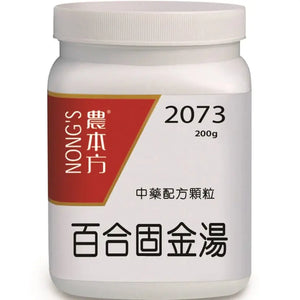
Q1: What are the actions of Bai He Gu Jin Tang?
Bai He Gu Jin Tang has the actions of nourishing the Yin of the Lung and Kidney, moistening the Lung, transforming phlegm, and stopping cough. It also clears deficiency Heat and helps cool the Blood to address blood-streaked sputum.
Q2: Which modern diseases is Bai He Gu Jin Tang suited to?
Modern TCM clinical practice commonly applies it to individuals whose pattern differentiation falls within Lung and Kidney Yin deficiency with deficiency Fire, including chronic bronchitis, bronchiectasis with blood-streaked sputum, chronic pharyngitis or laryngitis, pulmonary tuberculosis (as an adjunct), and post-viral or chronic dry cough.
Q3: Is Bai He Gu Jin Tang suitable for improving dry cough with blood-streaked sputum?
For presentations of dry cough (possibly with sticky or blood-streaked sputum), dry or sore throat, afternoon tidal fever, night sweats, hot palms and soles, a red tongue with little coating, and a thin rapid pulse — in those whose pattern differentiation confirms Lung and Kidney Yin deficiency with rising deficiency Fire — TCM commonly applies Bai He Gu Jin Tang as an adjunct. It cannot replace standard medical treatment.
Q4: Who should not take Bai He Gu Jin Tang?
Those with exterior pathogenic patterns (Wind-Cold or Wind-Heat), Phlegm-Dampness with copious sputum, Spleen deficiency with loose stools, or Yang deficiency are generally not suitable. The formula is rich, moistening, and cooling; misuse can trap exterior pathogens or worsen Dampness and digestive weakness. Use should be assessed by a qualified TCM physician.
Q5: Why is the formula named “Preserve the Metal”?
In Five-Element theory the Lung corresponds to Metal. The formula nourishes Lung Yin (and the supporting Kidney Yin) to “solidify” or preserve the Metal, preventing further damage from deficiency Fire and restoring the Lung’s moistening and descending functions.
Q6: Can Bai He Gu Jin Tang help with chronic dry throat or hoarseness?
Yes, when these symptoms arise from Lung and Kidney Yin deficiency with deficiency Fire scorching the throat. The formula moistens the Lung, generates fluids, and clears residual Heat, supporting relief of dryness and irritation when the pattern matches.
Q7: What are the main ingredients of Bai He Gu Jin Tang?
The classical formula includes Bai He (Lily bulb) to nourish Lung Yin and stop cough, Sheng Di Huang and Shu Di Huang to nourish Kidney and Lung Yin and cool Blood, Mai Men Dong and Xuan Shen to further nourish Yin and clear Heat, Bei Mu and Jie Geng to transform phlegm and benefit the throat, and Dang Gui, Bai Shao, and Gan Cao to nourish Blood and harmonize.
Q8: Is Bai He Gu Jin Tang suitable for long-term use?
It may be used for a course under professional supervision for chronic Yin deficiency patterns. Because many ingredients are rich and cloying, digestive function should be monitored; if Spleen weakness or loose stools appear, the formula may need modification or temporary discontinuation.
Q9: How does Bai He Gu Jin Tang address both the root and the branch?
It nourishes the root (Lung and Kidney Yin deficiency) while simultaneously addressing the branch symptoms of dry cough, phlegm, throat dryness, and deficiency Fire. This dual approach makes it effective for chronic dry cough patterns where both the underlying deficiency and the manifesting symptoms need attention.
Q10: What lifestyle advice supports the use of Bai He Gu Jin Tang?
Avoiding spicy, drying, or excessively heating foods and environments, maintaining moderate humidity, resting adequately, and protecting the respiratory tract from irritants help support Yin restoration. Professional medical monitoring remains essential, especially when bleeding or chronic respiratory disease is present.