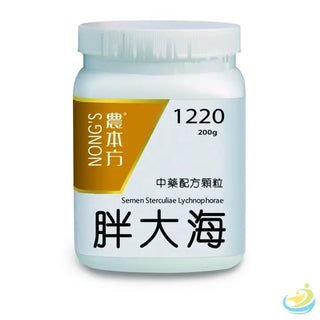
Fruits and seedsPhlegm-resolvingSterculiae Lychnophorae Semen

Pang Da Hai (Boat - fruited Sterculia Seed)

A practical guide to Pang Da Hai: what it is, how Traditional Chinese Medicine uses it, the classical formulas it appears in, and who should be careful with it.

View Herb Profile →

Last reviewed Oct 29, 2026

Quick Facts

Latin NameSterculiae Lychnophorae Semen
Chinese Name & Pinyin 胖大海 · Pang Da Hai
Medicinal PartFruits and seeds
The itemPang Da Hai is the dried ripe seed of Sterculia lychnophora. Jie Geng is not this herb. It is used raw, steeped in hot water.
Nature and channelsSweet, cold. Enters the Lung and Large Intestine. Sweet cold clears dryness-heat, benefits the throat, moistens the intestines, and frees the bowels.
Pharmacopoeia lineClears and benefits the throat, moistens the intestines and frees the bowels. Traditionally used for dryness-heat sore throat, hoarseness, dry cough, and intestinal dryness constipation.
Pattern cuesRed swollen painful throat. Hoarse voice after overuse. Dry hard stools. Dry mouth with bad breath.
In this articlePang Da Hai versus Jie Geng. Clearing dryness-heat versus diffusing lung qi. Why it is a short-term tea. Why a cold sore throat is a poor match. Who should skip it.

What Is Pang Da Hai?

Pang Da Hai (胖大海; Pàng Dà Hǎi; Latin: Sterculiae Lychnophorae Semen; English: boat-fruited sterculia seed) in the current pharmacopoeia is the dried ripe seed of Sterculia lychnophora of the sterculia family, collected in spring when the fruit pods split open. It is sweet and cold, enters the Lung and Large Intestine channels, and its core actions are to clear and benefit the throat, and to moisten the intestines and free the bowels. It is usually steeped in hot water rather than decocted for long. The usual amount is 2–3 pieces, or 5–10 g. It swells into a soft gel once soaked. A light tea with Gancao and Mai Dong is the common home form.

It is not Jie Geng. Platycodon root is bitter, acrid, and neutral; it disperses and diffuses lung qi to benefit the throat, and does not moisten the intestines. Pang Da Hai is cold and sweet; it drains dryness-heat and also loosens the bowels. A cold sore throat from catching a chill, with aversion to cold and a clear runny nose, is a poor match. Deficiency constipation with a pale face and tired qi is also not for self-use. Pregnancy needs a practitioner's call.

It is used most often for three patterns:

  • Dryness-heat throat: red, swollen, painful throat, hoarse voice after overusing the voice
  • Intestinal dryness constipation: dry hard stools, dry mouth, bad breath
  • Throat swelling with tonsil swelling and swollen painful gums — seek care

Sweet and cold, it is not a daily “voice tea” to keep brewing. Cooling when there is no dryness-heat damages spleen-stomach yang and loosens the stools.

When dryness-heat scorches the throat, or heat dries the intestines, red swollen throat, hoarseness, and hard dry stools are common. Pang Da Hai is sweet and cold. It clears the lung and large intestine of dryness-heat, which is why it assists in Qing Yan Li Ge Tang (Throat-Clearing Diaphragm-Benefiting Decoction)–type formulas for lung-stomach heat and Da Hai Gan Jie Yin (Sterculia, Licorice and Platycodon Drink)–type formulas for voice strain. It clears more than it holds. A cold, weak spleen and stomach, with no heat, get worse if more is added.

Pang Da Hai is not a catch-all voice-saving seed. In a cold sore throat, with spleen-stomach deficiency-cold, or in pregnancy, using it alone is a poor match. Steeped as a tea or paired in a formula, should be decided by a licensed Chinese medicine practitioner after pattern diagnosis.

Pang Da Hai

Pang Da Hai: Materia Medica Profile

Identification & Quality Standard

Sterculiae Lychnophorae Semen

Botanical Origin

The dried mature seed of Sterculia lychnophora Hance.(Sterculiaceae)

Production Regions

Primarily produced in Vietnam, Thailand, Indonesia, Malaysia.

Quality Requirements

Superior medicinal material is large, firm, brown, with thin wrinkles and luster.

Macroscopic Features

Fusiform or oval shape, 2~3cm long, 1~1.5cm diameter. Apex is blunt round; base is slightly pointed and crooked, with pale round hilum, externally brown or dark brown, slightly lustrous, with irregular dry and shriveled wrinkles. Outer layer of seed coat is extremely thin, brittle, easily falls off. Middle seed coat is relatively thick, black-brown, loose and easily broken, enlarges into a sponge-like shape when soaked in water. Fractured surface presents scattered resin-like spots. Inner seed coat can be peeled off from the middle layer of seed coat, slightly leathery, 2 thick fat endosperms inside, wide-oval shape; 2 cotyledons, very thin, tightly adhere to inside of endosperm, equal size as endosperm. faint odor, mild taste, sticky when chewed.

Main Regions and Quality Identification

Traditional materia medica and industry experience value the Southeast Asian producing regions, but actual quality also depends on variety, harvest time, processing, and storage. The main producing regions are Vietnam, Thailand, and Indonesia; there is also some small-scale cultivation in China. Good-quality Pang Da Hai is oval or spindle-shaped, with fine dense wrinkles on the surface, yellowish-brown to dark-brown in color, light and crisp in texture, swelling rapidly into a spongy translucent mass in water, with a very faint odor and a sticky feel when chewed. Common look-alikes are the seeds of other plants of the same genus — these swell far less in water, are harder, and lack the genuine product's spongy, fluffy feel.

Traditional Properties & Historical Lineage

Nature, Flavour & Channel Tropism

Sweet; ColdLungLarge Intestine

1. Records in Classic Materia Medica

  • Ben Cao Gang Mu Shi Yi: records that Pang Da Hai "treats fire-closed pox, and all heat conditions with consumptive injury, spitting blood and bleeding below, dispels toxin and summer heat, seasonal red eyes, wind-fire tooth pain, worm accumulations sending down food, hemorrhoid fistulas, dry cough without phlegm, bone-steaming internal heat, and triple-burner fire conditions."
  • Zhong Guo Yao Xue Da Ci Dian: records that it can "clear lung qi, resolve phlegm drool, and treat swollen painful throat."

These records mostly center on its clearing of dryness-heat and easing upper-body discomfort — corresponding to some modern daily-use scenes, but not directly equal to modern medical conclusions.

2. How Views of Its Nature Changed

Different physicians saw it somewhat differently. Some early physicians held that it has a certain tonifying action and can be used for the regulation of deficiency patterns — but later physicians increasingly found that Pang Da Hai's cold nature leans clear-draining and better fits the throat discomfort of excess-heat patterns; for deficiency patterns, it may worsen the internal cold instead. Other physicians emphasized its limited scope — that it cannot be used for all throat problems; for example, for cold throat pain from catching a chill, using Pang Da Hai actually worsens the discomfort. This change in understanding made Pang Da Hai's use fit actual clinical needs more closely, keeping it from being treated as a universal herb.

Pang Da Hai

Core Efficacies & Traditional Applications

Traditional Functions

Clears heat and moistens lung, benefits the throat and opens voice, and moistens intestines to free stools.

1. First Direction: Clearing and Benefiting the Throat

  • Traditional action: clear and benefit the throat — mainly for the red, swollen, painful throat and hoarse voice of dryness-heat or overuse of the voice.
  • Usual combinations: often paired with lung-qi clearing-scattering herbs — such as Jie Geng and Gan Cao — to strengthen the throat-benefiting effect while avoiding cold herbs alone damaging the stomach.
  • Who should not self-use: cold throat pain from catching a chill — for example, a sore throat with fear of cold and clear runny nose — is not suited to Pang Da Hai.

2. Second Direction: Moistening the Intestines and Freeing the Bowels

  • Traditional action: moisten the intestines and free the bowels — mainly for the dryness constipation of internally bound dryness-heat, shown as dry, hard stools and difficult bowel movements, possibly with dry mouth, bad breath, and dry throat.
  • Usual combinations: often paired with intestine-moistening herbs — such as Huo Ma Ren and Yu Li Ren — to strengthen the laxative effect.
  • Who should not self-use: deficiency constipation from insufficiency of qi and blood — for example, long-term constipation with a pale complexion and fatigue — is not suited to Pang Da Hai.

3. Classic Pairing: Pang Da Hai With Jie Geng

The common herb pair is Pang Da Hai with Jie Geng. Pang Da Hai enters mainly the lung channel, good at clearing and benefiting the throat and clearing-draining the dryness-heat in the lung; Jie Geng also enters the lung channel, good at xuan-fa (opening and diffusing) the lung qi and benefiting the throat. Together they coordinate — both clearing the dryness-heat in the lung and opening the lung qi, letting the throat's qi movement flow more freely — fitting the throat swelling-pain and hoarse voice of dryness-heat. It must be clear: this pair needs a practitioner's pattern diagnosis; do not combine and take it on your own — especially if you have a cold constitution.

Pang Da Hai

Modern Research

Modern research offers useful context, but Traditional Chinese Medicine prescribes on whole-pattern diagnosis rather than isolated compounds.

1. Main Chemical Constituents

Detected constituents include the sterculia substance (pangdahailin), polysaccharides, fatty acids, and flavonoids. In in vitro experiments, some extracts of Pang Da Hai were observed to inhibit certain common respiratory pathogenic bacteria to a certain extent; in animal experiments, after the extract was given to experimental animals, the intestinal peristalsis was observed to accelerate to a certain degree. There is not yet sufficient human clinical research reaching a clear conclusion on efficacy.

2. Current Research Directions

Current research mainly focuses on screening the active constituents related to anti-inflammation, throat-benefiting, and laxation. Studies show that the polysaccharide constituents may have some protective action on the respiratory mucosa; experiments observed that some extracts of Pang Da Hai ease the inflammation-caused throat discomfort of experimental animals. At present the work mainly focuses on the isolation of active constituents and preliminary pharmacological exploration — more human research is still needed to verify its actual action and safety in humans.

3. Limitations of Current Research

  • Lab results are not clinical efficacy — in vitro and animal results cannot be directly applied to humans.
  • Extracts and monomers are not the same as traditional decoction pieces — the extracts or monomers and the traditional Pang Da Hai slice are not the same dose form; they cannot be converted and used directly.
  • Sample sources, extraction methods, and doses vary between studies — different studies use different sources, extraction methods, and doses, so the results also differ.
  • A single component does not define the whole herb — a drug's action is often the joint result of many constituents.

Pang Da Hai

Comparing Similar Herbs

1. What They Share

Pang Da Hai and Jie Geng share three main points:

  • Both have throat-benefiting as a main action — both can ease throat discomfort.
  • Both are used for the throat patterns of lung-channel dryness-heat or qi blockage.
  • Both may appear in daily tea regulation — fitting light throat discomfort.
  • Both also need constitution and dose care — do not use casually long-term.

2. The Key Differences: Pang Da Hai vs. Jie Geng

  • Nature and flavors: Pang Da Hai is cold with a sweet flavor — a clear-draining item; Jie Geng is neutral with bitter-pungent flavors — a xuan-san (diffusing-scattering) item without obvious cold or heat leaning.
  • Focus: Pang Da Hai is better at clearing-draining the dryness-heat in the lung, and also moistens the intestines to free the bowels; Jie Geng is better at opening the lung qi and benefiting the throat — with no laxative action.
  • Qi tendency: Pang Da Hai has a clear-draining tendency — clearing and sending down the dryness-heat evil of the lung and intestines; Jie Geng has a xuan-san tendency — raising and opening the lung qi, helping the lung qi flow freely.
  • Best fit: Pang Da Hai fits the red, swollen, painful throat and hoarse voice of dryness-heat, together with dry mouth and constipation; Jie Geng fits the throat discomfort of lung-qi blockage — such as a throat foreign-body sensation and hoarse voice, possibly with cough and chest tightness.
  • Not suitable: Pang Da Hai is not for cold throat pain or deficiency constipation; Jie Geng is not for yin-deficiency chronic cough, qi counterflow, or hemoptysis.
  • Use scenes: Pang Da Hai better fits short-term dryness-heat regulation — such as seasonal throat discomfort and short-term bowel-dryness constipation; Jie Geng better fits chronic throat discomfort of lung-qi blockage, or cough with phlegm hard to expel.

3. One-Sentence Summary

Simply put, Pang Da Hai leans toward clearing and draining the dryness-heat of the lung and intestines, and also moistening the bowels, whereas Jie Geng leans toward opening the lung qi to benefit the throat. Both can be used for throat discomfort, but they are not interchangeable.

Pang Da Hai

Classical Formulas Containing Pang Da Hai

Formulas vs. Single Herbs

A formula is a whole in which many herbs act together — a single herb cannot simply replicate a full formula's effect, because the doses and combinations in a formula are holistic: each herb's amount and pairing is set by the severity of the pattern and the patient's constitution. Many readers wrongly think that because a herb works inside a formula, taking it alone will have the same effect — in fact, Pang Da Hai plays an auxiliary role in a formula, and used alone it only brings out part of the action and cannot reach the formula's overall regulating effect. Therefore, do not build your own formulas from online articles.

Diet & Daily Home Use

1. Home Tea and Porridge

Tea — Pang Da Hai Qing Yan Cha: raw Pang Da Hai 1 piece, Gan Cao 2 g, Mai Dong 3 g. Put the three in a cup, steep in boiling water, cover 10 minutes, and drink. Suited to the mild throat swelling-pain, hoarse voice, and dry mouth of overuse of the voice or seasonal dryness-heat. Not for those with spleen-stomach cold and frequent diarrhea, nor those with cold throat pain. Suggested: 2–3 times a week, one cup each time; do not drink continuously long-term. A reminder: Pang Da Hai is a medicinal slice, not an ordinary food — confirm whether your constitution fits before drinking.

Tea — Pang Da Hai Run Chang Cha: raw Pang Da Hai 1 piece, Huo Ma Ren 3 g. Put the two in a cup, steep in boiling water, cover 15 minutes, and drink. Suited to the short-term dry, hard stools and difficult bowel movements of dryness-heat, together with a dry throat. Not for cold constipation, spleen-stomach cold, or pregnant women. Suggested: 1–2 times a week, one cup each time; stop drinking once the symptoms ease.

2. Decoction and Processing Differences

There is little difference between the raw and processed Pang Da Hai — the raw product is the common one at present, needing no special processing. At home, Pang Da Hai is generally used by steeping — no pre-boiling, no late addition, and no bag-boiling are needed, because its active constituents dissolve easily in water and steeping releases them. When used in a decocted formula, it is usually soaked and decocted together with the other herbs, but not for too long, to avoid the volatile constituents escaping. It must be clear that doses of different forms cannot be converted directly — the tea dose and the prescription dose differ; do not adjust the dose casually.

3. Dosage and Course

The common dose of Pang Da Hai in traditional prescriptions is 2–3 pieces, or 5–10 g, adjusted to the pattern and the patient's constitution. The food-therapy dose is generally smaller — for example, only 1 piece in tea — to avoid discomfort from too large an amount. Long-term continuous use is not advised: generally regulate for 2–3 days and stop once the symptoms ease; if the symptoms persist, consult a doctor — do not drink long-term on your own.

Pang Da Hai

Contraindications & Safety Warnings

1. Who Should Avoid It

  • Spleen-stomach cold — people with frequent cold abdomen, diarrhea, and poor appetite; Pang Da Hai's cold nature worsens these discomforts.
  • Pregnancy and breastfeeding — special body states; there is not yet sufficient research proving Pang Da Hai's safety; avoid use.
  • Children and the elderly — children's organ functions are not yet fully developed and the elderly's organ functions gradually decline, with poorer drug tolerance; use with caution.
  • Liver or kidney impairment — drugs need liver-kidney metabolism; the cold nature may add burden to the liver and kidney.
  • Allergy to Pang Da Hai or Sterculiaceae (sterculia-family) plants — an allergic reaction may occur after use.
  • Those in special treatment — such as patients taking other medications — consult a doctor or pharmacist first to confirm suitability.

2. Interactions and Diet Notes

There is no clear documented interaction between Pang Da Hai and specific drugs, but it may affect the absorption or metabolism of anticoagulants, blood-pressure medications, and blood-sugar medications — people taking such drugs should consult a doctor or pharmacist first, and not self-use Pang Da Hai. There is no sufficient evidence for a general "food clash" between ordinary foods, but certain herbs can interact with specific drugs — anyone on medication should consult a doctor or pharmacist first. In daily diet, while taking Pang Da Hai, avoid eating too many raw-cold or greasy foods, to avoid burdening the spleen and stomach and affecting the action.

3. Adverse Reactions and Overdose Risk

Overdose of Pang Da Hai may bring spleen-stomach discomfort such as a cold abdomen, diarrhea, and nausea; long-term use may also damage the yang qi of the spleen and stomach. If marked discomfort, allergy signs such as rash and itching, persistent vomiting, breathing difficulty, altered consciousness, or rapidly worsening symptoms appear, stop at once and seek medical care — do not delay the condition.

Frequently Asked Questions About Pang Da Hai

What is Pang Da Hai? Are Mu Hu Die and Xuan Shen the same?
Pang Da Hai (胖大海) is the dried ripe seed of Sterculia lychnophora (Sterculiae Lychnophorae Semen), a common Chinese herb centered on clearing heat and moistening the Lung, benefiting the throat and opening the voice, and moistening the intestines and unblocking stool. Mu Hu Die clears the Lung and benefits the throat, leaning to soothing the Liver. Xuan Shen clears heat and cools blood, leaning to nourishing yin. The three cannot be interchanged by equal weight. Write Pang Da Hai. Use caution in Spleen-Stomach deficiency cold.
What is the composition and traditional use of Pang Da Hai?
Pharmacopoeial name Pang Da Hai, Latin Sterculia lychnophora Hance. Sweet, cold; enters the Lung and Large Intestine channels. It acts to clear heat and moisten the Lung, benefit the throat and open the voice, moisten the intestines and unblock stool. It is used for Lung-heat hoarseness, dry cough without phlegm, dry sore throat, heat constipation, headache and red eyes. Clears heat and benefits the throat.
How do you choose raw versus prepared? Can Mu Hu Die replace it?
Seeds used raw, steeped. Mu Hu Die leans to soothing the Liver without specialized intestinal-moistening; it cannot replace the formula by equal weight. Commercial products follow regulated processing; do not self-modify.
What is the usual dosage? Can it be drunk daily as a throat-benefiting tea?
Steeped, 2-3 pieces. Modern use requires a practitioner to name the dose. It is not a four-season “Pang Da Hai tea.” Spleen-Stomach deficiency cold only injures further. Hoarseness needs a practitioner to name a short course; it does not replace assessment.
What are the contraindications? Can it be used in pregnancy?
Not suitable for Spleen-Stomach deficiency cold with diarrhea. Pregnancy requires practitioner assessment. Stop if loose stool or abdominal pain appears. Severe hoarseness or high fever needs immediate medical care.
Can Pang Da Hai clear heat, moisten the Lung, benefit the throat, open the voice, moisten the intestines and unblock stool?
It can help Lung-heat hoarseness, dry cough without phlegm, dry sore throat, and heat constipation. It clears heat and moistens the Lung, benefits the throat and opens the voice, moistens the intestines and unblocks stool—not a specific for every hoarseness or every constipation.
Can Pang Da Hai be drunk daily as a throat-benefiting or intestinal-moistening tea?
Lung-heat hoarseness may enter a short formula; Spleen-Stomach deficiency cold only injures further. “Pang Da Hai must benefit the throat” does not replace assessment. Clearing heat, moistening the Lung, benefiting the throat, opening the voice, moistening the intestines and unblocking stool should be named by a practitioner with form and dose.
How do you choose among Pang Da Hai, Mu Hu Die, Xuan Shen, Jie Geng and Bo He?
Pang Da Hai clears heat and moistens the Lung while benefiting the throat, opening the voice and moistening the intestines, leaning to hoarseness and constipation. Mu Hu Die clears the Lung and benefits the throat, leaning to soothing the Liver. Xuan Shen clears heat and cools blood, leaning to nourishing yin. Jie Geng disperses the Lung and benefits the throat, leaning to expelling phlegm. Bo He disperses wind-heat, leaning to headaches. Benefiting the throat favors Pang Da Hai; soothing the Liver favors Mu Hu Die; nourishing yin favors Xuan Shen; dispersing the Lung favors Jie Geng; dispersing wind favors Bo He. They may be referenced after pattern differentiation; Spleen-Stomach deficiency cold forbids large Pang Da Hai.
How is Pang Da Hai commonly modified? What is the representative use?
Depends on the pattern. Hoarseness may add Mu Hu Die; constipation may add honey. Write Pang Da Hai; do not replace the intestinal-moistening action with an equal weight of Mu Hu Die.
How do you choose and store Pang Da Hai?
Choose regulated Chinese medicinal materials with intact seeds that swell after steeping. Discard if moldy, damp or off odor. Store in a dry place. Purchase labeled “Pang Da Hai”; do not use equal weights of Mu Hu Die or Xuan Shen to replace clearing heat, moistening the Lung, benefiting the throat, opening the voice, moistening the intestines and unblocking stool.

Medical Disclaimer — This article is provided for educational purposes only and describes traditional Chinese medicine concepts. It is not medical advice, and it is not intended to diagnose, treat, cure or prevent any disease. Always consult a qualified practitioner before using any herb, particularly if you are pregnant, nursing, taking medication or managing a diagnosed condition.

More Chinese Herbs

Login

Forgot your password?

Don't have an account yet?
Create account

Pang Da Hai (Sterculia Seed): Clears heat, moistens the lung, and benefits the throat