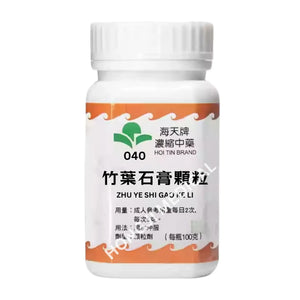
Q1: What are the actions of Zhu Ye Shi Gao Tang?
Zhu Ye Shi Gao Tang has the actions of clearing residual Heat, generating fluids, tonifying Qi, and harmonizing the Stomach. It is designed for the later stage of febrile disease when pathogenic Heat has largely subsided but residual Heat remains and Qi and Yin have been damaged.
Q2: Which modern diseases is Zhu Ye Shi Gao Tang suited to?
Modern TCM clinical practice commonly applies it to individuals whose pattern differentiation falls within residual Heat with Qi and fluid damage, including recovery stage of pneumonia, encephalitis, measles, influenza or other febrile illnesses, heat stroke or summerheat fever in the later phase, and certain presentations of diabetic thirst or post-illness weakness with lingering low-grade Heat.
Q3: Is Zhu Ye Shi Gao Tang suitable for improving lingering low-grade fever, thirst, irritability, and weakness after a febrile illness?
For presentations of lingering body heat with sweating, restlessness or irritability in the chest, thirst with desire to drink, possible mild nausea or rebellious Qi, fatigue and shortness of breath, a dry red tongue with little coating, and a deficient rapid pulse — in those whose pattern differentiation confirms residual Heat with Qi and Yin damage — TCM commonly applies Zhu Ye Shi Gao Tang as an adjunct. It cannot replace standard medical care.
Q4: Who should not take Zhu Ye Shi Gao Tang?
Those with high fever and strong excess Heat where Qi and Yin are still intact, internal Phlegm-Damp accumulation, or Yang-deficiency fever are generally not suitable. The formula is cool and moistening; it is inappropriate for pure excess Heat (better treated with Bai Hu Tang type formulas) or for Cold/Damp patterns. Use should be assessed by a qualified TCM physician.
Q5: Why does this formula combine Heat-clearing herbs with Qi- and Yin-tonifying herbs?
In the later stage of febrile disease the pathogen is weakened but not fully cleared, while the body’s Qi and fluids have already been damaged. Pure clearing would further deplete the upright Qi; pure tonification could retain the residual Heat. Zhu Ye and Shi Gao gently clear residual Heat while Ren Shen and Mai Men Dong restore Qi and Yin, achieving simultaneous clearing and supplementation.
Q6: Can Zhu Ye Shi Gao Tang help with both the residual Heat and the nausea or rebellious Stomach Qi that often appear in recovery?
Yes. Ban Xia is included specifically to direct rebellious Qi downward and harmonize the Stomach, addressing the mild nausea or desire to vomit that commonly accompanies residual Heat and fluid damage in the later stage of febrile illness.
Q7: What are the main ingredients of Zhu Ye Shi Gao Tang?
The classical formula includes Zhu Ye (Lophatherum) and Shi Gao (Gypsum) to clear residual Heat and relieve irritability; Ren Shen to tonify Qi; Mai Men Dong to nourish Yin and generate fluids; Ban Xia to harmonize the Stomach and stop rebellious Qi; and Zhi Gan Cao together with Jing Mi (rice) to protect and nourish the Middle Burner.
Q8: Is Zhu Ye Shi Gao Tang suitable for long-term use?
It is primarily a recovery-stage formula used until residual Heat clears and Qi and fluids begin to recover. Once the low-grade fever, thirst, and irritability resolve, the formula is typically discontinued or modified. Prolonged use of its cooling herbs is not necessary once the pattern has changed.
Q9: How does Zhu Ye Shi Gao Tang differ from Bai Hu Tang?
Bai Hu Tang is for full Yang Ming Qi-level excess Heat with high fever, great thirst, profuse sweating, and a flooding pulse, when upright Qi is still strong. Zhu Ye Shi Gao Tang is for the later stage when Heat is residual and milder, and Qi and Yin have already been damaged, requiring simultaneous clearing and tonification rather than pure draining of excess Heat.
Q10: What lifestyle advice supports the use of Zhu Ye Shi Gao Tang?
Adequate rest, light and easily digestible foods, gentle hydration, avoidance of spicy or heating foods, and protection from further heat exposure or overexertion help the formula clear residual Heat and restore Qi and fluids. Professional medical follow-up remains important during recovery from serious febrile illness.