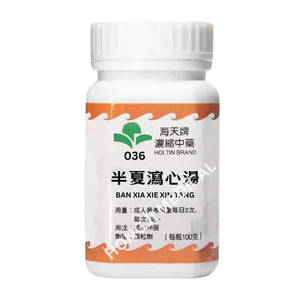
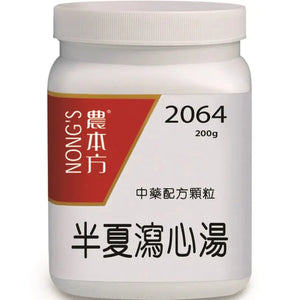
Q1: What are the actions of Ban Xia Xie Xin Tang?
Ban Xia Xie Xin Tang has the actions of harmonizing the Middle Burner, balancing Cold and Heat, dispersing focal distention (Pi), and directing rebellious Qi downward. It restores the normal ascending and descending functions of the Spleen and Stomach when Cold and Heat are tangled together.
Q2: Which modern diseases is Ban Xia Xie Xin Tang suited to?
Modern TCM clinical practice commonly applies it to individuals whose pattern differentiation falls within mixed Cold and Heat in the Middle Burner, including chronic gastritis, functional dyspepsia, gastroesophageal reflux (GERD), gastric or duodenal discomfort with mixed signs, and certain cases of chronic colitis or gastroenteritis presenting with epigastric fullness, nausea, and irregular stools.
Q3: Is Ban Xia Xie Xin Tang suitable for improving epigastric fullness, nausea, and diarrhea with mixed Cold-Heat signs?
For presentations of focal distention or fullness below the Heart (epigastrium) that is soft and not hard or severely painful on pressure, nausea or vomiting, borborygmus with loose stools or diarrhea, a sticky or slightly yellow tongue coating — in those whose pattern differentiation confirms mixed Cold and Heat disrupting Spleen-Stomach Qi dynamics — TCM commonly applies Ban Xia Xie Xin Tang as an adjunct. It cannot replace standard medical treatment.
Q4: Who should not take Ban Xia Xie Xin Tang?
Those with pure excess Heat, pure Cold deficiency, hard or painful epigastric masses, simple Qi stagnation or food accumulation without the mixed Cold-Heat pattern, or marked Yin deficiency with dryness are generally not suitable. Caution is required with Ban Xia in pregnancy. Use should be assessed by a qualified TCM physician.
Q5: Why does this formula combine both warm and cold herbs?
The pattern is one of Cold and Heat tangled together in the Middle Burner. Ban Xia and Gan Jiang are acrid and warm to disperse Cold and direct rebellious Qi downward; Huang Qin and Huang Lian are bitter and cold to clear Heat and dry Dampness. Using Cold and Heat together allows the formula to balance the mixed pathogens and restore the Spleen’s ascending and the Stomach’s descending functions.
Q6: Can Ban Xia Xie Xin Tang help when there is both upper Heat signs (such as bitter taste or yellow coating) and lower Cold signs (loose stools)?
Yes. This “upper Heat, lower Cold” or mixed presentation is a classic indication. The bitter-cold herbs address the Heat component while the acrid-warm herbs address the Cold and rebellious Qi, and the tonifying herbs support the underlying Middle Qi weakness that allows the disharmony to persist.
Q7: What are the main ingredients of Ban Xia Xie Xin Tang?
The classical formula consists of Ban Xia to direct rebellious Qi downward and disperse distention; Gan Jiang to warm the Middle and disperse Cold; Huang Qin and Huang Lian to clear Heat and dry Dampness; Ren Shen, Da Zao, and Zhi Gan Cao to tonify Qi, strengthen the Spleen, and harmonize the formula. Together they achieve the “acrid opening and bitter descending” strategy.
Q8: Is Ban Xia Xie Xin Tang suitable for long-term use?
It may be used for a course of treatment while the mixed Cold-Heat disharmony and epigastric distention are being resolved. Because it contains both warming and cooling elements plus tonics, it is relatively balanced, but ongoing use should still be monitored and adjusted by a practitioner as symptoms change.
Q9: How does Ban Xia Xie Xin Tang differ from pure Heat-clearing or pure warming Middle formulas?
Pure Heat-clearing formulas address excess Heat without the Cold component. Pure warming formulas (such as Li Zhong Tang) address Middle Cold without significant Heat. Ban Xia Xie Xin Tang is specifically for the complex situation in which Cold and Heat are simultaneously present and mutually constraining, producing soft epigastric distention with both upward rebellion and downward diarrhea.
Q10: What lifestyle advice supports the use of Ban Xia Xie Xin Tang?
Eating regular, moderate, easily digestible meals; avoiding raw cold foods, greasy foods, and excessive spicy or heating foods; reducing stress on the digestive system; and maintaining a calm eating environment help restore Spleen-Stomach ascending and descending functions. Professional evaluation remains important for persistent digestive symptoms.