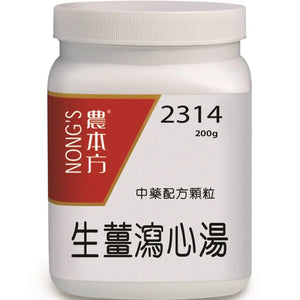
Sheng Jiang Xie Xin Tang: Classic TCM Formula for Stomach Deficiency with Mixed Cold and Heat
Sheng Jiang Xie Xin Tang (生姜泻心汤), known in English as Zingiber Decoction to Drain the Heart, is a classical formula from the Shang Han Lun for Stomach deficiency with Cold and Heat mixed causing epigastric fullness, nausea, vomiting, and diarrhea. It is particularly indicated for gastroenteritis, digestive disorders, or post-illness recovery with mixed Cold and Heat signs in the middle jiao. In modern clinical practice, Sheng Jiang Xie Xin Tang is widely used for patterns where the Stomach is deficient and invaded by both Cold and Heat, causing rebellious Qi and poor digestion. By warming the deficient Cold, clearing the excess Heat, and descending rebellious Qi, it effectively restores normal Stomach function in mixed Cold-Heat patterns.

I. Origins and History
1. Classical Literary Records
Sheng Jiang Xie Xin Tang originates from the Shanghan Lun (Treatise on Cold Damage), authored by the celebrated Eastern Han dynasty physician Zhang Zhongjing, and stands as one of the classical formulas of Chinese medicine. The Shanghan Lun, as the founding work of pattern differentiation and treatment for externally-contracted disease in Chinese medicine, has exerted a far-reaching influence on Chinese medicine clinical practice. Within the Shanghan Lun, Sheng Jiang Xie Xin Tang is primarily used to treat symptoms arising after cold-damage resolution through perspiration, where the stomach is disharmonised, presenting with hard glomus below the heart, dry belching with a rotten food odour, water qi below the hypochondrium, thunderous rumbling in the abdomen, and diarrhoea.
2. Historical Evolution and Transmission
Since the Shanghan Lun first appeared, Sheng Jiang Xie Xin Tang has consistently been valued and applied by later physicians. Physicians across the generations, while inheriting Zhang Zhongjing's academic thought, continuously enriched and developed the formula's scope of application and clinical experience. For example, the Jin-Yuan period physician Li Dongyuan, in his writings, further elaborated on the application of Sheng Jiang Xie Xin Tang, emphasising the important role of spleen-stomach weakness in disease onset; the warm-disease school of the Ming and Qing dynasties also drew upon the approach of Sheng Jiang Xie Xin Tang in the treatment of warm-heat diseases, applying it to treat conditions such as damp-heat obstruction of the interior and glomus and fullness of the middle burner.

II. Herb Composition (Sovereign, Minister, Assistant, Envoy)
1. Chief Herb — Ganjiang (Dry Ginger)
Ganjiang is acrid in flavour and hot in nature, entering the Spleen, Stomach, Kidney, Heart, and Lung channels. It has the actions of warming the middle and dispersing cold, restoring yang and unblocking the vessels, and warming the lungs to transform fluid retention. In Sheng Jiang Xie Xin Tang, Ganjiang serves as the chief herb, primarily exerting the action of warming the middle and dispersing cold, to restore spleen-stomach yang qi, eliminate cold pathogen from the middle burner, and allow normal spleen-stomach transforming and transporting function. Simultaneously, Ganjiang also assists Banxia in directing counterflow downward to stop vomiting, reinforcing the formula's action of harmonising the stomach and directing counterflow downward.
2. Deputy Herb — Shengjiang (Fresh Ginger)
Shengjiang is acrid in flavour and slightly warm in nature, entering the Lung, Spleen, and Stomach channels. It has the actions of releasing the exterior and dispersing cold, warming the middle and stopping vomiting, transforming phlegm and stopping cough, and resolving fish and crab toxicity. In this formula, Shengjiang is combined with Ganjiang: it can both reinforce the potency of warming the middle and dispersing cold, and restrain the dry-hot nature of Ganjiang, making it warm without being dry. In addition, Shengjiang can also harmonise the stomach and direct counterflow downward, relieving symptoms such as epigastric glomus and fullness and nausea and vomiting.
3. Assistant Herbs — Huanglian (Coptis Root) and Huangqin (Scutellaria Root)
Huanglian is bitter in flavour and cold in nature, entering the Heart, Spleen, Stomach, Liver, Gallbladder, and Large Intestine channels. It has the actions of clearing heat and drying dampness, and draining fire and resolving toxicity. Huangqin is bitter in flavour and cold in nature, entering the Lung, Gallbladder, Spleen, Large Intestine, and Small Intestine channels. It can clear heat and dry dampness, drain fire and resolve toxicity, stop bleeding, and calm the fetus. Huanglian and Huangqin, serving as assistant herbs in Sheng Jiang Xie Xin Tang, primarily exert the actions of clearing heat, drying dampness, draining fire, and resolving toxicity. Targeting the pathomechanism of glomus and fullness of the middle burner with internal obstruction by damp-heat, the two can clear and drain damp-heat from the spleen and stomach, eliminating the glomus and fullness, while simultaneously preventing Ganjiang and Shengjiang from being excessively warm-hot, lest they assist fire and generate heat.
4. Envoy Herbs — Banxia (Pinellia), Renshen (Ginseng), Dazao (Jujube) and Zhigancao (Honey-fried Licorice Root)
Banxia is acrid in flavour, warm in nature, and slightly toxic, entering the Spleen, Stomach, and Lung channels. It can dry dampness and transform phlegm, direct counterflow downward and stop vomiting, and dissipate glomus and disperse binds. Renshen is sweet and slightly bitter in flavour and slightly warm in nature, entering the Spleen, Lung, Heart, and Kidney channels; it greatly tonifies source qi, restores the pulse and rescues from collapse, tonifies the spleen and benefits the lungs, generates fluids and nourishes blood, and calms the spirit and boosts intelligence. Dazao is sweet in flavour and warm in nature, entering the Spleen, Stomach, and Heart channels; it can tonify the middle and boost qi, and nourish blood and calm the spirit. Zhigancao is sweet in flavour and neutral in nature, entering the Heart, Lung, Spleen, and Stomach channels; it tonifies the spleen and harmonises the stomach, and boosts qi and restores the pulse. These four herbs, serving as envoy herbs in Sheng Jiang Xie Xin Tang: Banxia directs counterflow downward to stop vomiting and dissipates glomus to disperse binds; combined with Renshen, Dazao, and Zhigancao, they both harmonise all the herbs and tonify and supplement the spleen and stomach, supporting the righteous and expelling the pathogen, restoring the spleen and stomach's ascending and descending functions, allowing middle-burner qi movement to become unobstructed and the symptoms of glomus and fullness to be eliminated.

III. Pathomechanism, Actions, and Indications
1. Pathomechanism Analysis
The pathomechanism targeted by Sheng Jiang Xie Xin Tang is primarily spleen-stomach weakness, with intermingling of cold and heat, disordered ascent and descent, and obstruction of qi movement. After cold damage has been resolved through perspiration, the qi of the spleen and stomach is damaged and its transforming and transporting function weakened, leading to middle-burner deficiency-cold. Simultaneously, as the pathogenic qi has not been fully expelled, it constrain and transforms into heat, forming the presentation of intermingled cold and heat. When the spleen and stomach are weak with disordered ascent and descent, clear qi fails to rise and turbid qi fails to descend, giving rise to symptoms such as hard glomus below the heart, dry belching with a rotten food odour, water qi below the hypochondrium, thunderous rumbling in the abdomen, and diarrhoea.
2. Actions
Sheng Jiang Xie Xin Tang has the actions of harmonising the stomach and dissipating glomus, and dispersing binds and eliminating water. Through regulating the spleen and stomach, restoring normal spleen-stomach ascending and descending functions, and eliminating the intermingled cold-heat pathogen from the middle burner, it achieves the goals of eliminating glomus and fullness, stopping vomiting, stopping diarrhoea, and promoting urination, allowing the body's qi movement to return to normal and zang-fu organ functions to be coordinated.
3. Indications
This formula is indicated for conditions arising after cold-damage resolution through perspiration, where the stomach is disharmonised, with hard glomus below the heart, dry belching with a rotten food odour, water qi below the hypochondrium, thunderous rumbling in the abdomen, and diarrhoea. Clinically, it is commonly used to treat conditions such as chronic gastritis, gastric ulcer, indigestion, and gastrointestinal functional disorders belonging to the pattern of spleen-stomach weakness with intermingled cold and heat.

IV. Formula Analysis
1. Combination of Ganjiang and Shengjiang
Ganjiang has a stronger potency for warming the middle and dispersing cold, while Shengjiang leans more toward releasing the exterior, dispersing cold, warming the middle, and stopping vomiting; combined, the two both reinforce the warming-the-middle and cold-dispersing action and mutually restrain each other's biased nature. With Shengjiang's assistance, Ganjiang is warm without being dry; with Ganjiang's warming nature, Shengjiang's exterior-releasing force becomes more gentle, with the emphasis on harmonising the stomach and directing counterflow downward. This method of combination embodies the characteristic of synergistic enhancement and mutual restraint among herbs within a formula, achieving the optimal therapeutic effect.
2. Combination of Huanglian and Huangqin with Ganjiang and Shengjiang
Huanglian and Huangqin are bitter and cold, capable of clearing heat and drying dampness, draining fire and resolving toxicity, thereby clearing and draining damp-heat from the middle burner; Ganjiang and Shengjiang are acrid and hot, capable of warming the middle and dispersing cold. Their combination uses cold and heat together — acrid opening and bitter descending. The cold herbs clear and drain the heat pathogen, preventing the warm-hot herbs from assisting fire and generating heat; the hot herbs warm and scatter the cold pathogen, restraining the cold herbs from being excessively cold and damaging the middle. This allows the intermingled cold and heat of the middle burner to be brought into balance and the symptoms of glomus and fullness to be eliminated.
3. Combination of Banxia, Renshen, Dazao, and Zhigancao
Banxia directs counterflow downward to stop vomiting and dissipates glomus to disperse binds; combined with Renshen, Dazao, and Zhigancao, it has the action of harmonising the spleen and stomach and supporting the righteous to expel the pathogen. Renshen, Dazao, and Zhigancao tonify and supplement the qi of the spleen and stomach, reinforcing spleen-stomach transforming and transporting function and enhancing the body's resistance; Banxia directs counterflow to harmonise the stomach, eliminating symptoms such as epigastric glomus and fullness and nausea and vomiting. The four herbs acting together allow the spleen-stomach weakness to be restored, ascending and descending functions to normalise, and the pathogenic qi to be expelled.

V. Comparison with Related Formulas
1. Comparison with Banxia Xiexin Tang
Banxia Xiexin Tang and Sheng Jiang Xie Xin Tang both originate from the Shanghan Lun and are both used to treat glomus patterns with intermingled cold and heat. The distinction between the two is that Banxia Xiexin Tang uses Banxia as the chief herb, with an emphasis on transforming phlegm and dispersing binds and dissipating glomus to eliminate fullness — suited to glomus patterns where phlegm-qi is relatively more exuberant; Sheng Jiang Xie Xin Tang, by contrast, uses Ganjiang and Shengjiang as chief herbs, with an emphasis on warming the middle and dispersing cold together with harmonising the stomach and dissipating glomus — suited to glomus patterns complicated by water qi and dry belching with a rotten food odour.
2. Comparison with Gancao Xiexin Tang
Gancao Xiexin Tang is also used to treat glomus patterns; its composition is similar to Sheng Jiang Xie Xin Tang, but with a heavier dosage of Zhigancao. Gancao Xiexin Tang emphasises tonifying the spleen and harmonising the stomach, and boosting qi to restore the pulse, suited to glomus patterns with more pronounced middle-qi weakness — clinically presenting with diarrhoea dozens of times daily, undigested food in the stool, thunderous rumbling in the abdomen, and hard, full glomus below the heart. Sheng Jiang Xie Xin Tang, comparatively, presents with a relatively milder degree of middle-qi weakness, focusing primarily on harmonising the stomach to dissipate glomus and dispersing binds to eliminate water.

VI. Clinical Applications
1. Digestive System Disorders
Sheng Jiang Xie Xin Tang is widely applied in the treatment of digestive system disorders. For patients with chronic gastritis and gastric ulcer presenting with symptoms such as epigastric glomus and fullness, pain, nausea and vomiting, poor appetite, and a bitter taste or dry mouth, with the pattern identified as spleen-stomach weakness with intermingled cold and heat, Sheng Jiang Xie Xin Tang may be selected for treatment. Modern research has demonstrated that Sheng Jiang Xie Xin Tang can regulate gastrointestinal function, promote gastrointestinal peristalsis, enhance the protective action of gastric mucosa, and reduce inflammatory responses, thereby relieving digestive system symptoms.
2. Gastrointestinal Functional Disorders
Gastrointestinal functional disorder patients commonly present with symptoms such as abdominal pain, diarrhoea, constipation, abdominal distension, and belching; TCM pattern differentiation frequently identifies this as spleen-stomach weakness with intermingled cold and heat. Sheng Jiang Xie Xin Tang can improve the symptoms of gastrointestinal functional disorder by regulating spleen-stomach function and balancing cold and heat. Clinical practice has confirmed that Sheng Jiang Xie Xin Tang produces good therapeutic results for symptoms such as epigastric glomus and fullness, poor appetite, and nausea and vomiting caused by functional dyspepsia; it also provides a degree of relief for symptoms such as abdominal pain and alternating diarrhoea and constipation caused by irritable bowel syndrome.
3. Other Conditions
Beyond digestive system disorders, Sheng Jiang Xie Xin Tang may also be used to treat certain other conditions. For example, for conditions such as oral ulcers and bad breath, if the pattern is identified as spleen-stomach weakness with damp-heat internally accumulating, Sheng Jiang Xie Xin Tang may also be applied for treatment. In addition, during the late stage of some warm-heat diseases, when symptoms such as uncleared residual heat, spleen-stomach weakness, and glomus and fullness of the middle burner appear, Sheng Jiang Xie Xin Tang can also exert its action of harmonising the spleen and stomach and clearing residual heat.

VII. Clinical Modifications
1. For Concurrent Exterior Pattern
If the patient also presents with exterior-pattern symptoms such as aversion to cold, fever, and headache, exterior-releasing herbs such as Guizhi (Cinnamon Twig) and Baishao (White Peony Root) may be appropriately added to the base formula to release the exterior and disperse the pathogen, allowing the pathogens of both exterior and interior to be simultaneously treated.
2. For More Exuberant Dampness Pathogen
If dampness pathogen is more exuberant, with symptoms such as heaviness and fatigue of the limbs and a thick greasy tongue coating, water-disinhibiting and dampness-percolating herbs such as Fuling (Poria), Zexie (Alisma Rhizome), and Yiyiren (Coix Seed) may be added to reinforce the dampness-dispelling potency.
3. For Liver Constraint with Qi Stagnation
If the patient is accompanied by symptoms of liver constraint and qi stagnation, such as distending pain in the hypochondrium and emotional depression, liver-soothing and qi-regulating herbs such as Chaihu (Bupleurum Root), Zhike (Bitter Orange Fruit), and Xiangfu (Cyperus Rhizome) may be added to regulate and smooth the qi movement.
4. For Internal Obstruction by Blood Stasis
If manifestations of internal blood-stasis obstruction are present, such as stabbing epigastric pain and a dark purple tongue, blood-activating and stasis-resolving herbs such as Danshen (Salvia Root), Chishao (Red Peony Root), and Taoren (Peach Kernel) may be added to eliminate the blood stasis.

VIII. Dosage and Preparation (Traditional Method and Modern Concentrated Granules)
1. Traditional Method
The traditional method is to weigh the herbs — Ganjiang, Shengjiang, Huanglian, Huangqin, Banxia, Renshen, Dazao, and Zhigancao — in set dosages, then add water and decoct. Generally: Ganjiang 3 liang (9 g), Shengjiang 4 liang (12 g), Huanglian 1 liang (3 g), Huangqin 3 liang (9 g), Banxia half sheng (12 g), Renshen 3 liang (9 g), Dazao 12 pieces, Zhigancao 3 liang (9 g). Begin with 1 dou of water, decoct to 6 sheng, remove the dregs, then re-decoct to 3 sheng; take 1 sheng warm, three times daily.
Traditional "Remove Dregs and Re-Decoct" Method for Sheng Jiang Xie Xin Tang
An introduction to the herb composition and proportions of the classical Shanghan Lun formula Sheng Jiang Xie Xin Tang, and a detailed guide to the highly meticulous "remove dregs and re-decoct" (qù zǐ zài jiān) special concentrated slow-decoction and warm-administration method from the Eastern Han Shanghan Lun.
- Shengjiang (Fresh Ginger): 4 liang (approx. 12 g)
- Banxia (Pinellia): half sheng (approx. 12 g)
- Ganjiang (Dry Ginger): 3 liang (approx. 9 g)
- Huangqin (Scutellaria Root): 3 liang (approx. 9 g)
- Renshen (Ginseng): 3 liang (approx. 9 g)
- Zhigancao (Honey-fried Licorice Root): 3 liang (approx. 9 g)
- Huanglian (Coptis Root): 1 liang (approx. 3 g)
- Dazao (Jujube): 12 pieces
- Water: 1 dou in classical measure (add a sufficient amount of clean water for modern decoction)
2. Modern Concentrated Granules
Modern concentrated granules are granule preparations produced from traditional Chinese herbs through extraction, concentration, and related processes, convenient to take. When using modern concentrated granules, the dosage may be calculated by converting from the traditional formula dosage. For example: Ganjiang concentrated granules 9 g, Shengjiang concentrated granules 12 g, Huanglian concentrated granules 3 g, Huangqin concentrated granules 9 g, Banxia concentrated granules 12 g, Renshen concentrated granules 9 g, Dazao concentrated granules equivalent to 12 jujubes (according to the specific product instructions), and Zhigancao concentrated granules 9 g. Simply dissolve these granules in an appropriate amount of boiled water to take.

IX. Precautions and Contraindications
1. Dietary Restrictions
During the course of taking Sheng Jiang Xie Xin Tang, a light diet should be maintained and spicy, greasy, and raw, cold irritating foods should be avoided, to prevent adding burden to the gastrointestinal tract and affecting drug efficacy. Simultaneously, smoking and alcohol should be avoided, and regular eating habits maintained.
2. Constitutional Differences
For those with a deficiency-cold constitution, the dosage of Ganjiang and Shengjiang may be appropriately reduced; for those with a heat-prone constitution, the dosage of Huanglian and Huangqin may be appropriately increased. However, the specific dosage should be adjusted by a physician according to the patient's specific circumstances and should not be self-adjusted.
3. Special Populations
Special populations such as pregnant women, breastfeeding women, and children should use Sheng Jiang Xie Xin Tang with caution, and should do so under medical guidance. This is because the physiological characteristics of these populations differ from those of ordinary people, and the use of the herbs may produce different effects upon them.
4. Changes in Condition
During the course of taking Sheng Jiang Xie Xin Tang, if the patient's condition changes — such as worsening symptoms or the appearance of new symptoms — medical attention should be sought promptly and the treatment plan adjusted; the original formula should not be blindly continued.

X. Modern Research
1. Pharmacological Action Research
Sheng Jiang Xie Xin Tang originates from the Shanghan Lun and is a formula for treating glomus and fullness below the heart caused by intermingled cold and heat with retained water fluid, possessing the actions of acrid opening and bitter descending, and combining attack with tonification. It is primarily indicated for symptoms such as dry retching, thunderous rumbling in the abdomen with diarrhoea, persistent belching, intestinal rumbling with downward flux, vexing restlessness, and sweating, suited to conditions such as chronic gastritis. The formula consists of Shengjiang 12 g, Huanglian 3 g, Renshen 9 g, Huangqin 9 g, Banxia 9 g, and others; clinically, it may be modified in combination with Dahuang Huanglian Xiexin Tang, Fuzi Xiexin Tang, and Huangqin Tang, suited to patterns of disordered ascent and descent such as counterflowing guest-qi, glomus with water qi below the hypochondrium, intermingled cold and heat, and dry belching with rotten food odour. It is also discussed in the Yizong Jinjian (Golden Mirror of Medical Orthodoxy).
Modern research has demonstrated that Sheng Jiang Xie Xin Tang possesses multiple pharmacological actions. It can regulate gastrointestinal motility, promote gastrointestinal peristalsis, enhance gastric emptying capacity, and improve gastrointestinal functional disorders. Simultaneously, Sheng Jiang Xie Xin Tang also has anti-inflammatory, antibacterial, and antiviral actions, capable of reducing gastrointestinal inflammatory responses and inhibiting the growth and proliferation of pathogens such as Helicobacter pylori. In addition, this formula can also regulate the body's immune function and strengthen the body's resistance.
2. Clinical Efficacy Observation
Extensive clinical research has confirmed the effectiveness of Sheng Jiang Xie Xin Tang in treating digestive system disorders and related conditions. Research has demonstrated that Sheng Jiang Xie Xin Tang, in treating conditions such as chronic gastritis and gastric ulcer, can significantly improve patients' symptoms of epigastric glomus and fullness, pain, and nausea and vomiting, and improve the healing rate of gastric mucosa as observed under endoscopy. For gastrointestinal functional disorder patients, Sheng Jiang Xie Xin Tang can also effectively relieve symptoms such as abdominal pain, diarrhoea, and constipation, improving patients' quality of life.
3. Exploration of Mechanism of Action
Regarding the mechanism of action of Sheng Jiang Xie Xin Tang, further in-depth research is still ongoing. Some studies suggest that Sheng Jiang Xie Xin Tang may improve gastrointestinal function by regulating the secretion of gastrointestinal hormones such as gastrin and motilin. In addition, the formula may also exert its therapeutic action by regulating intestinal flora balance and enhancing intestinal barrier function. Simultaneously, the regulatory action of Sheng Jiang Xie Xin Tang on the neuroendocrine-immune network is also receiving attention; it may improve the pathological state of the body through multiple pathways and multiple targets.
In summary, Sheng Jiang Xie Xin Tang, as a classical Chinese medicine formula, possesses rich content and extensive application value. Through a detailed introduction to its origins and history, herb composition, pathomechanism and actions, formula analysis, comparison with other formulas, clinical applications, modifications, dosage and preparation, precautions, and modern research progress, it is hoped that more people will come to understand and appreciate this formula, providing useful reference for clinical treatment and Chinese medicine education.
Sheng Jiang Xie Xin Tang — Frequently Asked Questions
Q1: What are the therapeutic actions of Sheng Jiang Xie Xin Tang?
Sheng Jiang Xie Xin Tang has the actions of harmonising the stomach and directing counterflow downward, dispersing binds and dissipating glomus, and strengthening the spleen and stopping diarrhoea. It is primarily used for epigastric glomus and fullness, acid reflux and belching, intestinal rumbling with diarrhoea, and disordered digestive function caused by disharmony of stomach qi.
Q2: What modern conditions is Sheng Jiang Xie Xin Tang used for?
In modern TCM clinical practice, it is commonly used for gastroesophageal reflux disease (GERD), chronic gastritis, functional dyspepsia, irritable bowel syndrome (IBS), chronic diarrhoea, and gastrointestinal dysmotility, among individuals whose presentation corresponds to the pattern of intermingled cold and heat with disharmony of the spleen and stomach.
Q3: Is Sheng Jiang Xie Xin Tang suitable for acid reflux and stomach bloating?
For those who long experience acid reflux, belching, abdominal bloating, postprandial fullness, and epigastric glomus and fullness, accompanied by intestinal rumbling with diarrhoea and related symptoms, TCM practitioners commonly apply Sheng Jiang Xie Xin Tang through pattern differentiation to regulate spleen-stomach function.
Q4: Who should not take Sheng Jiang Xie Xin Tang?
Those with severe spleen-stomach deficiency-cold, no glomus and fullness symptoms, simple stomach yin insufficiency, or excess-heat accumulation should generally not use Sheng Jiang Xie Xin Tang. Treatment should be prescribed by a qualified TCM practitioner based on pattern differentiation according to the specific pattern type.
⚠️ This content is for reference only and does not provide medical advice. Consult a healthcare professional for any health concerns.