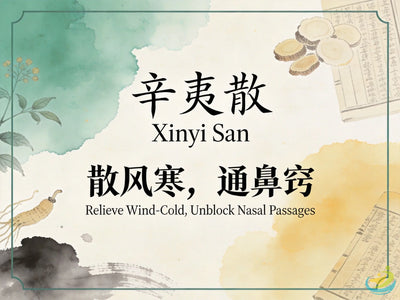
Exterior-Releasing Formulas

優鼻湯 · Yōu Bí Tāng

You Bi Tang

A nasal formula for stuffy nose and rhinorrhea from wind.

View formula profile →
Last reviewed October 2026
Formula CategoryExterior-Releasing Formulas
Primary PatternWind-Cold
Primary FunctionDispel wind, open the nose
Primary Therapeutic PrincipleDispel wind and open the nose
Main HerbsMagnolia Flower · Angelica Dahurica Root · Saposhnikovia Root · Mentha / Peppermint · Platycodon Root · Licorice Root
Classical SourceLater nasal formula

Why This Formula?

Selected for wind nasal congestion rather than lung-heat sinus patterns.

Selected for wind nasal congestion rather than lung-heat sinus patterns.

What Is You Bi Tang?

1. Where the Formula Comes From

You Bi Tang (优鼻汤), or Excellent-Nose Decoction, is a nose-care formula whose prototype goes back to a folk prescription of mid-Qing physicians in the Jiangnan region. It belongs to the category of formulas that open the nasal passages, strengthen the spleen to resolve damp, and build the qi to guard the body surface.

The formula targets the pattern of lung-spleen qi deficiency with damp-phlegm blocking the nasal passages. Typical signs include a stuffy nose (worse with cold or fatigue), sticky white nasal discharge, sneezing with clear discharge in allergic rhinitis, and the runny nose, headache, and reduced sense of smell of chronic sinusitis. It is widely used for chronic simple rhinitis, allergic rhinitis, and chronic sinusitis.

In the humid, canal-rich Jiangnan of the Qing, with many people fond of sweet, rich foods, blocked noses and endless discharge were common. A physician living in Suzhou watched local farmers boil Xin Yi Hua with Cang Er Zi to drink for their noses, and combined that with the Huang Di Nei Jing's ideas — "the nose is the opening of the lung" and "where it passes, there is no pain" — to select herbs that open the nose and clear the lung. The formula circulated among neighbors but never entered the official formularies.

You Bi Tang

2. Chronic Simple Rhinitis

Chronic simple rhinitis is long-standing inflammation of the nasal lining — intermittent or alternating stuffiness (lighter with daytime activity, worse lying down at night or in cold), sticky white discharge, usually no real headache. On the formula, most patients feel clearly better stuffiness relief in 1–2 weeks and are largely recovered in 1–2 months. In practice many report breathing freely without depending on nasal drops, and far less discharge — no more blowing the nose a dozen times a day. Note: avoid prolonged cold-air exposure and very spicy food, which would re-congest the lining.

3. Allergic Rhinitis

Allergic rhinitis brings an itchy nose, sneezing (a dozen to dozens a day), and clear watery discharge, triggered by pollen or dust mites and worse in seasonal changes. You Bi Tang works on the "lung-spleen qi deficiency" root: after 1–2 months the sneezing and clear discharge clearly lessen and flare frequency drops. Clinically, patients who relapsed every spring have, after three months on the formula, had a much lighter attack that year and a delayed one the next — evidence that by adjusting the constitution it raises resistance and calms the allergic response. In a bad acute flare, combine with anti-allergy drugs; in the stable phase, the formula is the better choice.

4. Chronic Sinusitis

Chronic sinusitis is inflammation of the sinus linings — stuffiness, purulent discharge, possibly headache and reduced smell, lasting over three months (sometimes years). The formula mainly helps drain the pus, improve airflow, and strengthen the spleen to make less mucopurulent discharge. In milder cases, 2–3 months noticeably improves stuffiness and discharge; heavier cases may need local treatments like nasal irrigation as well. Notably, these patients often have weak digestion (poor appetite, loose stools), and on the formula both the nose and the stomach improve — supporting the "open and build" design.

You Bi Tang

5. Other Nose Conditions

It also assists less common cases: atrophic rhinitis (dry nasal lining, stuffiness, reduced smell) — the damp-resolving action eases the dryness while strengthening the spleen improves fluid distribution; post-polypectomy care — the still-swollen lining recovers faster and polyps are less likely to return; and rhinitis medicamentosa from years of nasal drops — the formula helps the lining recover and break the drops' dependency.

Herb Composition (Sovereign / Minister / Assistant / Envoy)

1. The Lords: Xin Yi Hua and Cang Er Zi

Both are the core nose-opening herbs:

  • Xin Yi Hua (Magnolia Flower) — warm, pungent; enters the lung and stomach; acts straight on the nose, so it's called "the herb of the nasal passages." It scatters wind-cold and opens the nose, and modern work finds it eases congestion and swelling of the nasal lining.
  • Cang Er Zi (Xanthium / Cocklebur) — warm, sweet-bitter; enters the lung; dispels wind and damp and opens the nose, especially good for sticky discharge and stuffiness.

Together — one warms and frees the nasal network, one dries damp and clears discharge — they carry the core "open the nose" action.

2. The Ministers: Bai Zhi and Bo He

Bai Zhi (Angelica Dahurica) — warm, pungent; enters the lung and stomach; scatters wind, dries damp, and stops the nose-area pain (headache over the brow bone) while reducing the sticky secretions. Bo He (Mint) — cool, pungent; scatters wind-heat and clears the head, easing the dizziness and pressure that often come with nose trouble; its light, clear nature carries the other herbs upward to the nose. One warm, one cool — they balance the lords' warm-dry tendency and add pain relief and head-clearing.

3. The Assistants: Fu Ling, Bai Zhu, Chen Pi

Fu Ling (Poria) — neutral, sweet-bland; strengthens the spleen and drains damp. Bai Zhu (Atractylodes) — warm, sweet; strengthens the spleen and builds qi. The pair dry and resolve damp at its source — TCM says "the spleen is the source of phlegm," and the nose's sticky discharge is a kind of damp-phlegm, so strengthening the spleen cuts off the supply. Chen Pi (Tangerine Peel) — warm, pungent; moves qi, strengthens the spleen, and dries damp to dissolve phlegm, helping Fu Ling and Bai Zhu work and protecting the stomach from the warm-dry herbs.

You Bi Tang

4. The Courier: Gan Cao

Gan Cao (Licorice) — warm, sweet; enters the heart, lung, spleen, and stomach; harmonizes all the herbs — checking Xin Yi Hua's and Cang Er Zi's warmth and Bo He's coolness, so the whole formula is mild enough for long-term use. It also builds the spleen-qi, backing up the assistants and tying the formula together.

Clinical Presentation in TCM

1. The Root Problem It Treats

The core pattern is "lung-spleen qi deficiency, damp-phlegm blocking the passages, with the nasal network obstructed." The lung governs the nose — lung qi and fluids nourish it — so when lung qi is deficient the fluids fail to spread and gather into damp-phlegm. The spleen transforms and transports water-damp; when spleen qi is deficient, damp cannot be metabolized and reaches the lung, giving a "lung-spleen both deficient" state. The damp-phlegm then settles in the nasal passages along the channels, causing a swollen nasal lining, stuffiness, discharge, and even headache and loss of smell. The key is that deficiency and obstruction coexist: merely opening the nose doesn't fix the root — you also need to strengthen the spleen and lung to make less damp-phlegm, so the nose stays open.

2. What It Does

Its action works on three levels:

  • Open the nasal passages — directly eases the congestion and swelling of the lining and quickly improves stuffiness.
  • Strengthen the spleen and resolve damp — cuts nasal secretions at the source so the discharge stops returning.
  • Build qi and guard the surface — by tonifying lung and spleen, raises resistance so wind-cold and damp don't re-invade the nose and trigger relapses.

So it isn't a one-sided "open" — it's "open and build together," made for chronic nose patients.

You Bi Tang

3. Whom It's For

  • Chronic simple rhinitis — intermittent or alternating stuffiness, sticky white discharge, worse with cold or fatigue.
  • Allergic rhinitis — itchy nose, sneezing, clear discharge, flaring in seasonal changes or on contact with allergens.
  • Chronic sinusitis — stuffiness, purulent discharge, headache, reduced smell, lasting over three months.
  • Spleen-weak recurrent nose patients — even without classic rhinitis, mild stuffiness plus fatigue and poor appetite can also be regulated with it.

The Mechanism in Classical Theory

1. Open and Build Together: Treating Branch and Root

The design combines "open" with "build," handling both the immediate and the underlying problem. The branch — today's stuffiness and discharge — is met by the lords Xin Yi Hua and Cang Er Zi opening the nose directly, with Bai Zhi and Bo He easing the local discomfort. The root — the recurring basis of lung-spleen deficiency with damp-phlegm blocking the passages — is met by Fu Ling and Bai Zhu strengthening the spleen and lung to make less damp-phlegm. This avoids the two classic mistakes: using only nose-opening herbs (which would dry the fluids) or only tonics (which would pile up damp-phlegm).

2. A Balanced Nature: Warm and Cool, Drying and Moistening

The formula's nature is balanced by pairing. Xin Yi Hua, Cang Er Zi, Bai Zhi, and Bai Zhu are warm; Bo He is cool — so the warmth doesn't dry and injure the fluids, and the coolness doesn't chill the spleen-stomach. Fu Ling and Chen Pi dry damp and dissolve phlegm, while Bo He's light, clear, moistening quality loosens the sticky secretions so they drain more easily — without the dryness leaving the nose parched. This balance lets the formula suit most constitutions; cold or heat-leaning nose patients can use it as long as the syndrome is read correctly.

You Bi Tang

3. Carrying the Effect Up to the Nose

The courier and ministers work to concentrate the effect where it belongs. Bo He's light, clear nature carries the medicine upward to the nasal passages; Bai Zhi's lung-stomach channel entry (the lung opens to the nose) concentrates the effect around the nose; and Gan Cao's harmonizing keeps every herb pulling in the same direction. So the formula doesn't act vaguely on the whole body — it targets the nose, which is what makes it precise.

Clinical Comparison Table

Compare You Bi TangCang Er SanXin Yi SanXin Yi Qing Fei Tang
Primary Function Dispel wind, open the noseDisperse wind, unblock the noseDisperse wind, unblock the nasal orificesClear Lung heat, open the nasal orifices
Formula Category Exterior-Releasing FormulasExterior-Releasing FormulasExterior-Releasing FormulasHeat-Clearing Formulas
Typical TCM Pattern Wind-ColdWind-ColdWind-ColdLung Heat
Main Conditions Nasal Congestion, Allergic Rhinitis, HeadacheNasal Congestion, Headache, Allergic RhinitisNasal Congestion, Headache, Allergic RhinitisNasal Congestion, Dry Mouth & Throat, Headache, Fever
Main Herbs Magnolia Flower · Angelica Dahurica Root · Saposhnikovia Root · Mentha / Peppermint · Platycodon Root · Licorice RootXanthium Fruit · Magnolia Flower · Angelica Dahurica Root · Mentha / PeppermintMagnolia Flower · Angelica Dahurica Root · Saposhnikovia Root · Ligusticum Root · Cimicifuga Rhizome · Akebia Stem · Chuanxiong Rhizome · Asarum / Wild GingerMagnolia Flower · Scutellaria / Baikal Skullcap · Gypsum · Anemarrhena Rhizome · Ophiopogon Tuber · Angelica Dahurica Root · Cimicifuga Rhizome · Licorice Root · Loquat Leaf
Classical Source Later nasal formulaJi Sheng Fang (Yan Yonghe, Song dynasty)Ji Sheng Fang (Yan Yonghe, Song dynasty)Wai Ke Zheng Zong (Chen Shigong, Ming dynasty)

How to tell them apart

You Bi Tang, Cang Er San and Xin Yi San open the nose. Cang Er San and Xin Yi San are classical nasal formulas. This formula disperses wind and opens the nose.

For educational reference only, based on traditional pattern differentiation — not a substitute for professional advice.

Clinical Modifications for You Bi Tang

1. For Severe Stuffiness

If stuffiness is extreme (mouth-breathing at night, disturbed sleep), add Lu Lu Tong and Shi Chang Pu — one frees the network and opens the passages, one opens the orifice and dissolves phlegm. Many severe cases feel relief the same day and sleep better. Keep each at about 10 g — too much can irritate the nose.

2. For Heavy Discharge

If discharge is copious — clear fluid even dripping into the throat, with phlegm and cough — add Xi Xin and Gan Jiang: one scatters cold and opens the passages, one warms the middle and transforms fluids, warming the lung's cold-phlegm and cutting the clear discharge. These patients are usually chilly with cold hands and feet; the additions help that too. Keep Xi Xin at about 3 g (never over 5 g) to avoid toxicity.

3. For Marked Headache

For obvious headache — brow-bone or forehead pain, common in sinusitis — raise Bai Zhi (from 10 g to 15 g), add Chuan Xiong and Man Jing Zi: the first moves blood and qi and stops wind-pain, the second scatters wind-heat and clears the head. They strengthen the pain relief and improve sinus circulation so inflammation absorbs; headaches usually ease within 3–5 days.

4. For Marked Spleen Weakness

For clear spleen-qi deficiency (poor appetite, bloating, loose stools, fatigue, sallow face), add Huang Qi and Dang Shen, 15 g each, to build lung-qi and spleen-qi alongside the existing Bai Zhu and Fu Ling — improving digestion and cutting damp-phlegm at the source. Avoid sweet and greasy food while on them, which would load the spleen.

You Bi Tang

5. For Heat-Leaning Constitutions

For the heat-leaning patient (dry mouth, bitter taste, dry stools, sticky yellow discharge, easy "fire"), cut Bai Zhu and Cang Er Zi to 6 g each and add Huang Qin and Sang Bai Pi, 10 g each — clearing heat, drying damp, and draining the lung. This balances the formula's warm-dry side, avoids "fire," and reduces the inflamed yellow discharge.

What the Science Suggests

1. What the Active Compounds Do

  • Xin Yi Hua — volatile oils (eucalyptol, eugenol and others) improve nasal circulation, ease congestion and swelling, and inhibit histamine release to calm allergy.
  • Cang Er Zi — the glycoside xanthostrumarin is anti-inflammatory and antibacterial, reducing inflammatory nasal secretions.
  • Bo He — the oil stimulates the lining, supports mucus flow, and cools and soothes the itch.
  • Bai Zhu — atractylodes polysaccharides strengthen immunity, raising resistance and cutting attacks.

These compounds together give the formula its scientific footing.

2. Clinical Verification

Recent trials support the traditional use. In one study of 120 chronic simple rhinitis patients, after two months on the formula 85% had clearly better stuffiness and 78% much less discharge. In another, 80 allergic rhinitis patients took it for three months: 65% had attack frequency fall by more than half, with clearly lower symptom scores. The evidence is that it genuinely improves chronic nose disease and reduces recurrence.

3. Safety Studies

Safety monitoring finds no obvious side effects at normal doses and no liver or kidney damage. Some patients get slight dry mouth — a normal effect of the warm herbs — relieved by drinking water, not requiring stopping. Compared with Western nose medications, the side effects are smaller, which suits the long-term use chronic patients need.

4. Directions for Improvement

Ongoing work explores making You Bi Tang a nasal spray, so the effect hits the lining directly and acts faster; using modern purification to isolate the active compounds into a convenient proprietary form; and studying its effect on nasal-lining repair, to better explain how it adjusts the constitution and cuts relapses — so the formula can serve clinical practice even better.

Safety Considerations

1. Pregnancy and Breastfeeding

You Bi Tang contains nose-opening herbs (Xin Yi Hua, Cang Er Zi) and spleen herbs (Bai Zhu, Fu Ling). Although mild, it can contract the uterus — especially in the first three months of pregnancy, risking miscarriage — so it must not be used in pregnancy. Breastfeeding women should consult a doctor before using it (herbs can reach the milk); saline nasal rinses are often the better first choice rather than self-medicating.

2. Allergy to Any Herb

If allergic to any ingredient (e.g., Xin Yi Hua), a rash, itching, or breathing difficulty means do not use it. Before the first full dose, try a small amount (about 100 ml), watch for an hour, and proceed only if nothing reacts. If allergy appears, stop at once, drink water, and seek care if severe.

3. Acute Nose Trouble: Short Use Only

The formula is for chronic care. Acute rhinitis (e.g., a cold-driven attack) does respond, but the illness is short and urgent — a classic like Cang Er Zi San usually suffices, and You Bi Tang should not be taken beyond 10 days, to avoid lingering effect and rebound. If acute symptoms don't improve after 3 days on it, see a doctor — there may be bacterial infection needing antibiotics.

4. Special Groups

Children need adjusted doses — usually 1/2 to 2/3 of the adult dose, since their digestion is still developing — and always under a doctor. Older patients, especially with hypertension or heart disease, should watch for dizziness or palpitations; the formula doesn't affect blood pressure or the heart, but any such discomfort means stop and consult.

5. Lifestyle While Taking It

Avoid spicy, greasy, and sweet food (chili, fried food, cake) — they load the spleen, make more damp-phlegm, and blunt the effect. Avoid smoking and alcohol, which irritate the lining and worsen stuffiness. Keep warm and avoid drafts and over-air-conditioned rooms (very low temperatures weaken the lung qi and trigger relapse). Keep regular hours — staying up late drains the qi-blood and weakens the conditioning effect.

Questions About You Bi Tang

Q1: What is You Bi Tang? Are Cang Er Zi San and Yu Ping Feng San the same?
You Bi Tang (优鼻汤) is a formula used in TCM to relieve nasal congestion, rhinorrhea and allergic rhinitis, centered on dispelling wind, dispersing cold, unblocking orifices and securing the exterior for wind-cold or wind-heat causing nasal congestion and rhinorrhea, or recurrent sneezing and nasal itching. Cang Er Zi San dispels wind and unblocks orifices, leaning to bi yuan with nasal congestion. Yu Ping Feng San tonifies qi and secures the exterior, leaning to insecure defensive qi with susceptibility to external pathogens. The three cannot be interchanged by equal weight. Write You Bi Tang. Use caution in Spleen-Stomach vacuity cold and pregnancy.
Q2: What is the composition and traditional use of You Bi Tang?
Core composition: Xin Yi, Cang Er Zi, Bai Zhi, Bo He, Huang Qi, Fang Feng, Gan Cao. It acts to dispel wind, disperse cold, unblock orifices and secure the exterior. It is used for nasal congestion and rhinorrhea from wind-cold or wind-heat, recurrent sneezing and nasal itching from allergic or chronic rhinitis, and headache, dizziness or reduced smell from sinusitis. Xin Yi, Cang Er Zi and Bai Zhi unblock orifices; Bo He disperses wind-heat; Huang Qi and Fang Feng tonify qi and secure the exterior; Gan Cao harmonizes.
Q3: How do you choose raw versus prepared? Can Cang Er Zi San replace it?
Cang Er Zi must be prepared. Cang Er Zi San lacks Huang Qi and Fang Feng for securing the exterior; it cannot replace the formula by equal weight. Commercial products follow regulated compounding; do not self-modify.
Q4: What is the usual dosage? Can it be drunk daily as a nose-unblocking tea?
Ancient use was decoction. Modern use adjusts proportions; common as decoction or granules, with dose named by a practitioner. It is not a four-season “Superior Nose tea.” Cang Er Zi has mild toxicity and should not be used long-term in excess. Nasal congestion needs a practitioner to name a short course; it does not replace assessment.
Q5: What are the contraindications? Can it be used in pregnancy?
Spleen-Stomach weakness, pregnancy and children require practitioner assessment. Cang Er Zi has mild toxicity and should not be used long-term in excess. Stop if dry mouth or loose stool appears. Fever, purulent nasal discharge or worsening symptoms need immediate medical care.
Q6: Can You Bi Tang dispel wind, disperse cold, unblock orifices and secure the exterior?
It can help nasal congestion and rhinorrhea from wind-cold or wind-heat, and recurrent sneezing from allergic rhinitis. It dispels wind, disperses cold, unblocks orifices and secures the exterior—not a specific for every rhinitis or every nasal congestion.
Q7: Can You Bi Tang be drunk daily as a wind-dispelling, orifice-unblocking or exterior-securing tea?
Nasal congestion and rhinorrhea may enter a short formula; Spleen-Stomach weakness only injures further. “Magnolia flower must unblock orifices” does not replace ENT assessment. Dispelling wind, dispersing cold, unblocking orifices and securing the exterior should be named by a practitioner with form and dose.
Q8: How do you choose among You Bi Tang, Cang Er Zi San, Yu Ping Feng San, Xin Yi Qing Fei Yin and Bi Yan Kang?
You Bi Tang dispels wind and disperses cold while unblocking orifices and securing the exterior, containing Xin Yi, Cang Er Zi, Bai Zhi, Huang Qi, Fang Feng and Bo He, leaning to nasal congestion and rhinorrhea with insecure defensive qi. Cang Er Zi San dispels wind and unblocks orifices, leaning to bi yuan. Yu Ping Feng San tonifies qi and secures the exterior, leaning to susceptibility. Xin Yi Qing Fei Yin clears the Lung and unblocks orifices, leaning to Lung heat bi yuan. Bi Yan Kang clears heat and unblocks orifices, leaning to wind-heat. Insecure defensive qi with nasal congestion favors You Bi Tang; bi yuan favors Cang Er Zi; susceptibility favors Yu Ping Feng; Lung heat favors Xin Yi Qing Fei. They may be referenced after pattern differentiation; Spleen-Stomach vacuity cold forbids large You Bi Tang.
Q9: How is You Bi Tang commonly modified? What is the representative use?
The original already contains dispelling wind, unblocking orifices and securing the exterior. Marked wind-cold may add Xi Xin; Lung heat may add Huang Qin. Write You Bi Tang; do not replace the exterior-securing action with an equal weight of Cang Er Zi San.
Q10: How do you choose and store You Bi Tang?
Choose regulated Chinese patent medicines or compounded decoctions that list the composition. Moldy, damp, or abnormal-smelling lots are discarded. Store cool and dry. Buy “You Bi Tang”; do not replace dispelling wind, dispersing cold, unblocking orifices and securing the exterior with an equal weight of Cang Er Zi San or Yu Ping Feng San.

General Questions

How do I choose the right formula?
TCM formulas are traditionally selected according to individual pattern differentiation rather than by symptom alone. If you're not sure which formula fits your presentation, take our AI Assessment below for a personalized starting point, then confirm with a qualified TCM practitioner.
What are concentrated herbal granules?
Concentrated herbal granules are made by decocting raw herbs, then extracting and concentrating the resulting liquid into a fine granule or powder form. This preserves the same active compounds as a traditional decoction while making the herbs far easier to store, measure, and prepare.
How should I take these products?
Dissolve the recommended amount of granules in hot water, stir until fully dissolved, and drink while warm — following the dosage and frequency advised by your TCM practitioner or as stated on the product packaging.
Are concentrated herbal granules equivalent to traditional decoctions?
Concentrated granules are produced from the same herbs and processed to retain their active compounds, so they are traditionally regarded as a convenient alternative to decoctions rather than a different remedy. Some practitioners note subtle differences in strength or absorption between the two forms, so your TCM practitioner may adjust dosage accordingly.
Are your products authentic?
Yes. HJMEDICAL sources its concentrated granules exclusively from established, reputable manufacturers such as Nong's and Hoi Tin, both long-standing names in the TCM granules industry, with GMP compliance stated directly on their packaging.
Are HJMEDICAL products manufactured under GMP standards?
HJMEDICAL sources its concentrated granules from established, reputable manufacturers such as Nong's and Hoi Tin, both long-standing names in the TCM granules industry. GMP compliance for these products is stated directly on their packaging.
Do you ship internationally?
Yes — we ship worldwide! Every order goes out via Hong Kong Post, and your exact shipping cost and estimated delivery time for your address are calculated and shown right at checkout, so there are never any surprises. We also offer free shipping once your order reaches our free-shipping threshold, so it's easy to stock up on your favorite formulas and save.
Can I take more than one formula at the same time?
Some formulas are traditionally combined, while others overlap or counteract each other. We recommend checking with a qualified TCM practitioner before combining formulas, especially if you are already taking other medication.
Are these products suitable during pregnancy or breastfeeding?
Some TCM formulas are not suitable during pregnancy or breastfeeding. Please consult a qualified TCM practitioner or your doctor before use if you are pregnant, trying to conceive, or nursing.
Do these products replace medical treatment?
No. These products are traditional herbal supplements intended to support wellbeing according to TCM principles — they are not a replacement for professional medical diagnosis or treatment. Please consult a qualified TCM practitioner or licensed healthcare provider before starting, stopping, or combining any treatment, especially if you have a chronic condition.
Medical Disclaimer

For general TCM education only — not medical advice. Consult a qualified TCM practitioner or licensed healthcare provider before use, especially if pregnant, nursing, on medication, or managing a chronic condition.

Not sure which formula is right for you?

Take the AI Assessment

最新文章

Login

Forgot your password?

Don't have an account yet?
Create account

You Bi Tang: Opening the Nasal Orifices and Clearing Heat