Q1: What are the actions of Ding Chuan Tang?
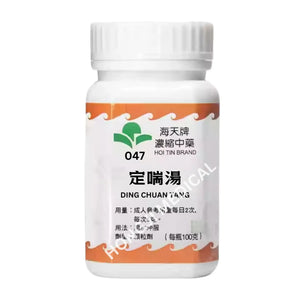
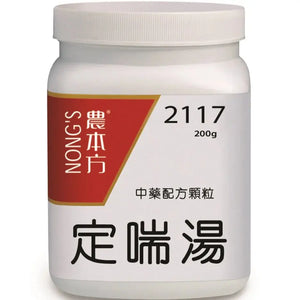
Ding Chuan Tang has the actions of diffusing and descending Lung Qi, clearing Heat, transforming Phlegm, and arresting wheezing. It is designed for wheezing caused by residual Wind-Cold on the exterior with Phlegm-Heat accumulated in the Lung.
Q2: Which modern diseases is Ding Chuan Tang suited to?
Modern TCM clinical practice commonly applies it to individuals whose pattern differentiation falls within Phlegm-Heat in the Lung, including bronchial asthma or asthmatic bronchitis with thick yellow phlegm, acute exacerbations of chronic bronchitis or COPD of Phlegm-Heat type, and infection-triggered wheezing when exterior Cold and interior Heat coexist.
Q3: Is Ding Chuan Tang suitable for improving wheezing and cough with thick yellow phlegm?
For presentations of wheezing and panting, cough with copious thick yellow or sticky phlegm, chest tightness, possible mild aversion to wind, a yellow greasy tongue coating, and a slippery rapid pulse — in those whose pattern differentiation confirms exterior Cold with interior Phlegm-Heat — TCM commonly applies Ding Chuan Tang as an adjunct. It cannot replace standard asthma or emergency respiratory treatment.
Q4: Who should not take Ding Chuan Tang?
Those with pure Wind-Cold wheezing without interior Phlegm-Heat, chronic deficiency asthma from Lung-Kidney Qi or Yin deficiency, or dry cough without Phlegm are generally not suitable. Caution is required in hypertension, heart disease, and pregnancy because of Ma Huang, and Bai Guo should not be overdosed. Use should be assessed by a qualified TCM physician.
Q5: Why does this formula pair Ma Huang with Bai Guo?
Ma Huang diffuses the Lung, releases residual exterior Cold, and arrests wheezing by opening constrained Lung Qi. Bai Guo astringes the Lung, transforms Phlegm, and also arrests wheezing. The pair is “one dispersing, one astringing”: together they strengthen the anti-wheeze effect while Bai Guo prevents Ma Huang from overly scattering Lung Qi.
Q6: How does Ding Chuan Tang differ from Xiao Qing Long Tang or Su Zi Jiang Qi Tang?
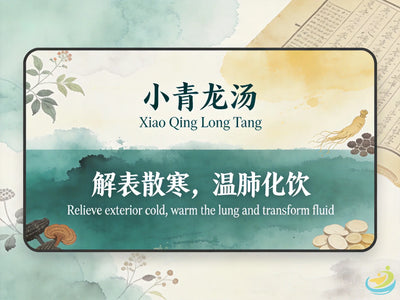
Xiao Qing Long Tang treats exterior Cold with interior Cold-Phlegm (thin white watery sputum). Su Zi Jiang Qi Tang treats upper excess and lower deficiency with more Cold-Phlegm and Kidney failing to grasp Qi. Ding Chuan Tang is for the mixed pattern of residual exterior Cold plus interior Phlegm-Heat with thick yellow sputum and a yellow greasy coating.
Q7: What are the main ingredients of Ding Chuan Tang?
The classical formula consists of Ma Huang to diffuse the Lung and arrest wheezing; Bai Guo to astringe the Lung and transform Phlegm; Xing Ren, Su Zi, Kuan Dong Hua, and Ban Xia to descend Qi, stop cough, and transform Phlegm; Sang Bai Pi and Huang Qin to clear Lung Heat; and Gan Cao to harmonize.
Q8: Is Ding Chuan Tang suitable for long-term use?
No. It is an acute or short-course formula for Phlegm-Heat wheezing, often after an exterior trigger. It contains no tonifying herbs and includes Ma Huang and Bai Guo, which should not be used continuously. Once the wheeze and yellow phlegm settle, the formula should be stopped or changed to a constitutional formula.
Q9: Can Ding Chuan Tang be used when there is still a mild aversion to wind together with yellow phlegm?
Yes. That combination is a classical hallmark: residual Wind-Cold still binding the exterior while Phlegm has already transformed into Heat in the Lung. Mild chills or aversion to wind plus thick yellow phlegm and a yellow greasy coating support this formula rather than a purely exterior-Cold or purely interior-Heat prescription.
Q10: What lifestyle advice supports the use of Ding Chuan Tang?
Avoiding wind-cold exposure, reducing greasy and Phlegm-producing foods, keeping the chest warm, and resting during acute wheezing help the formula diffuse the Lung and clear Phlegm-Heat. Severe or sudden asthma attacks require immediate conventional emergency care; this formula is only an adjunct after proper pattern differentiation.