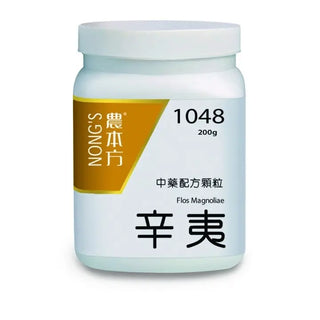
FlowersExterior-releasingFlos Magnoliae

Xin Yi (Magnolia Flower)

A practical guide to Xin Yi: what it is, how Traditional Chinese Medicine uses it, the classical formulas it appears in, and who should be careful with it.

View Herb Profile →

Last reviewed Oct 13, 2026

Quick Facts

Latin NameFlos Magnoliae
Chinese Name & Pinyin 辛夷 · Xin Yi
Medicinal PartFlowers
The herbXin Yi is the dried, densely hairy flower bud of the magnolias above. Bag-decoct it. Cang Er Zi, Bai Zhi, and Hou Po are different official drugs.
Nature and channelsAcrid, warm. Enters the Lung and Stomach. Acridity disperses wind-cold and unblocks the nose.
Pharmacopoeia lineDisperses wind-cold. Unblocks the nasal orifices. Used for wind-cold headache, stuffed nose and runny nose, allergic sniveling, and deep-source nasal congestion.
Pattern cuesStuffed nose and turbid discharge. Deep-source nasal congestion. Allergic sniveling. Wind-cold headache.
In this articleXin Yi versus Cang Er Zi, Bai Zhi, Xi Xin, and Hou Po. Why it is bag-cooked. Why yin-deficiency dryness should skip it. Who should skip it.

What Is Xin Yi?

Xin Yi (辛夷; Xīn Yí; Latin: Magnoliae Flos; English: magnolia flower bud) is the dried flower bud of Magnolia biondii Pamp., Magnolia denudata, or Magnolia sprengeri. In Chinese medicine it is a warm, acrid exterior-releasing herb. It is acrid and warm, enters the Lung and Stomach channels, and its core actions are to disperse wind-cold and unblock the nasal orifices. In a decoction it must be bag-cooked, or the hairs irritate the throat. It is not Hou Po. Magnolia bark dries dampness, moves qi, and directs rebellion down to calm wheeze. Xin Yi is a flower bud and is specific for the nose. It is not Cang Er Zi. Xanthium is toxic and also dispels wind-damp. Xin Yi is aromatic and opens the orifices, with a different safety profile. Garden magnolia blossoms are not the official piece. Use caution in yin-deficiency fire.

It is used most often for three patterns:

  • Stuffed nose, deep-source nasal congestion, allergic sniveling — turbid discharge, loss of smell
  • Wind-cold headache
  • Wind-cold attacking the Lung with stuffed runny nose

The usual decoction dose is 3–10 g, bag-cooked. Acrid-warm and aromatic, it is not a daily “open-the-nose magnolia tea.” Unblocking when there is no wind-cold, or a dry burning nose from yin deficiency, gets drier if more warmth is added.

When wind-cold blocks the nasal orifices, stuffed nose, turbid discharge, and forehead pain are common. Xin Yi is acrid-warm. It disperses and unblocks, which is why it is paired with Cang Er Zi and Bai Zhi. It moves more than it moistens. Dry mouth, nosebleed, and a red tongue with little fluid get worse if more fragrance is added.

Xin Yi is not a catch-all sinus flower. In yin-deficiency fire or a dry hot nasal cavity, using it alone can assist dryness. Whether it belongs in Cang Er Zi San or Xin Yi San should be decided by a licensed Chinese medicine practitioner after pattern diagnosis.

Xin Yi Magnolia Flower

Xin Yi: Materia Medica Profile

Identification & Quality Standard

Flos Magnoliae

Botanical Origin

The dried flower bud of Magnolia biondii Pamp., Magnolia denudate Desr., Magnolia sprengeri Pamp.(Magnoliaceae)

Production Regions

Primarily produced in the Chinese provinces of Anhui, Henan, Hubei.

Quality Requirements

Superior medicinal material has unopened flower bud, tight, intact, without stem, with potent aromatic odor.

Macroscopic Features

Magnolia biondii Pamp.: Long oval shape similar to a calligraphy brush head, 1.2~2.5cm long, 0.8~1.5cm diameter. Base often has short stem, about 5mm long, with off-white spotted lenticels. 2~3 layers of bracts, 2 pieces each layer, small scale bud between ever two layers, outer surface of bract densely covered grayish-white or grayish-green hairs, inner surface is brownish, without hairs. 9 perianth, brownish, outer whorl has 3 perianths, strip-like, about 1/4 length of 2 inner whorls, calyx-like, 2 inner whorls have 6 perianths, 3 for each, wheel-like arranged. Stamen and pistil are numerous and arranged in a spiral. Light in weight, brittle texture. aromatic odor, acrid, cooling and slightly bitter taste. Magnolia denudate Desr.: 1.5~3cm long, 1~1.5cm diameter. Base has relatively thick and strong stem, pale brown lenticels. Outer surface of bracts is densely covered with grayish-white or grayish-green hairs. 9 perianths, same shape of inner and outer perianths. Magnolia sprengeri Pamp.: 2~4cm long, 1~2cm diameter. Thick and strong stem, reddish-brown lenticels. Outer surface of bract densely covered pale yellow or pale yellowish-green hairs, some outermost bract hairs have fallen off and have a black-brown color. 10~12~15 perianths, no obvious difference between inner and outer whorls.

3 Authentic Sourcing and Quality Identification

While traditional texts favor specific regions (like Henan, Sichuan, or Anhui), the actual quality depends heavily on the plant variety, timing of the harvest, and storage.

  • High Quality: Premium Xin Yi features intact, unopened buds. They should have dense fuzz, an even color, a lightweight, dry texture, and a pleasant, mild spicy fragrance.
  • Poor Quality: Buds that have already opened, lost their fuzz, smell moldy, or show bug damage are considered low quality.
  • Watch Out: It is easy to confuse it with other magnolia varieties that have sparse fuzz and a weak scent, so careful identification is key.

Traditional Properties & Historical Lineage

Nature, Flavour & Channel Tropism

Acrid; WarmLungStomach

1. 2 Historical Records

Classic TCM texts have documented this herb for centuries:

  • Shen Nong Ben Cao Jing: Listed as a middle-grade herb, noted for treating wind-induced headaches and facial ailments.
  • Ming Yi Bie Lu: Mentioned its ability to warm the middle body, clear nasal congestion, and even help with toothaches.
  • Ben Cao Gang Mu: Clarified that its warm, spicy nature enters the Lungs and helps clear energy rise to the head, making it excellent for facial, eye, and nasal issues.
  • Classic Pairings: Texts like De Pei Ben Cao note that it is often paired with Chuan Xiong (Szechuan Lovage Root) or Cang Er Zi (Xanthium) to effectively target severe nasal congestion.

2. 3 Evolution of TCM Understanding

Over time, the understanding of Xin Yi has evolved. Early practitioners focused strictly on its ability to fight off external "wind-cold" causing stuffy noses. Later, others realized it could also help regulate Stomach Qi.

  • Crucial Caution: Because it is a warm herb, modern TCM doctors warn against using it carelessly for "heat-type" nasal issues (like thick, yellow mucus with a red tongue). It is a specialized tool, not a universal cure for every runny nose.

Xin Yi Magnolia Flower

Core Efficacies & Traditional Applications

Traditional Functions

Dispels wind, opens nose. Apply to headache, persistent turbid nasal discharge, nasal obstruction, toothache.

1. 1 First Primary Action: Dispersing Wind-Cold and Unblocking Nasal Passages

The core traditional function of Xin Yi (Magnolia Flower) is using its warm, spicy nature to drive out wind-cold and open up blocked nasal passages.

  • Common Symptoms: It is primarily used for nasal congestion, clear runny nose, and loss of smell caused by catching a cold, often accompanied by headaches and a dislike of the cold.
  • Common Pairings: For wind-cold stuffiness, it is often paired with Fang Feng (Saposhnikovia Root) and Bai Zhi (Angelica Root) to enhance the cold-dispersing effect. If the congestion comes with a mild headache, it is paired with Xi Xin (Asarum) and Chuan Xiong (Szechuan Lovage Root) to move Qi in the head and face.
  • Caution: Do not use this if you have a "heat" constitution (dry mouth, constipation) or heat-type nasal issues (thick yellow mucus, red and swollen nasal passages). Its warming nature can make heat symptoms worse. Pregnant women should also avoid using it without supervision.

2. 2 Second Primary Action: Unblocking Orifices to Relieve Headaches

Xin Yi (Magnolia Flower) is also used to clear nasal passages specifically to relieve facial and head pain.

  • Common Symptoms: Headaches triggered by severe nasal congestion or wind-cold, usually felt around the forehead or temples, alongside a stuffy or runny nose.
  • Common Pairings: It is frequently combined with pain-relieving herbs like Bai Zhi (Angelica Root) and Gao Ben (Chinese Lovage Root). For sinus-type headaches with deep congestion, it is paired with Cang Er Zi (Xanthium) and Bo He (Peppermint) to clear out stagnant energy.
  • Caution: It is not suitable for headaches caused by "Liver fire" (symptoms include dizziness, red face, irritability). People with severe high blood pressure or extreme headaches should not self-medicate with this herb.

3. 3 Common Single Herb Pairing: The Herb Pair

A very famous and effective pairing in TCM is Xin Yi (Magnolia Flower) and Cang Er Zi (Xanthium).

  • Xin Yi focuses on opening up the Qi (energy) of the nasal passages, while Cang Er Zi excels at dispelling wind and dampness to clear out stubborn blockages.
  • Together, they are highly effective for wind-cold congestion, clear runny noses, and loss of smell.
  • Safety Note: This pairing requires a doctor's prescription. Cang Er Zi has mild toxicity, so its dosage must be strictly controlled, and it is not suitable for every type of nasal problem.

Xin Yi Magnolia Flower

Modern Research

Modern research offers useful context, but Traditional Chinese Medicine prescribes on whole-pattern diagnosis rather than isolated compounds.

1. 1 Primary Chemical Components

Modern science has taken an interest in Xin Yi, focusing largely on its essential oils.

  • Active Compounds: It contains volatile oils, lignans, and flavonoids.
  • Lab Findings: The volatile oil is what gives the herb its signature scent. In test tubes, these oils show some ability to inhibit common respiratory bacteria. Animal tests suggest the extracts might help ease nasal stuffiness, though extensive human clinical data is still pending.

2. 2 Modern Pharmacological Focus

Current laboratory research primarily investigates how Xin Yi interacts with the respiratory system.

  • Nasal Health: Studies look at how the volatile oils might regulate the microscopic hairs (cilia) in the nasal passages, helping them function normally.
  • Inflammation: Animal models show a potential reduction in nasal inflammation, but we need more human trials to confirm these benefits for daily use.

3. 3 Limitations of Modern Research

While lab results are promising, it is important to view them through a grounded lens:

  • Lab vs. Real Life: What works in a petri dish or a lab mouse does not automatically translate to human healing.
  • Concentration Differences: Highly concentrated lab extracts are vastly different from a traditional cup of brewed herbal tea.
  • Variables: Differences in the plant's origin, harvest time, and prep methods make it hard to create a standardized scientific conclusion.
  • Holistic Action: TCM relies on the synergy of the whole herb (often mixed with other herbs in a formula), which cannot be fully understood by just isolating one single chemical compound.

Xin Yi Magnolia Flower

Comparing Similar Herbs

1. 2 Similarities with Comparable Herbs

When comparing Xin Yi (Magnolia Flower) to Cang Er Zi (Xanthium):

  • Both disperse wind-cold and unblock nasal passages.
  • Both treat stuffy noses, runny noses, and related headaches.
  • Both must be used with caution by people with "heat" constitutions, and overdosing can cause discomfort.

2. 3 Core Differences

  • Nature and Action: Xin Yi is mild, lightweight, and gently moves upward to clear the head. Cang Er Zi is much more drying, slightly toxic, and has a stronger ability to dry up dampness in the body.
  • Primary Focus: Xin Yi is better at opening the airway, making it great for loss of smell and facial pressure. Cang Er Zi is better at drying up excessive, thick mucus and relieving damp-related joint pain.
  • Symptom Profile: Use Xin Yi for milder congestion with clear mucus and upper-head pain. Use Cang Er Zi for severe, heavy congestion with a lot of mucus and body aches.

3. 4 One-Sentence Summary

Xin Yi gently unblocks nasal passages to restore smell and relieve headaches, while Cang Er Zi strongly dries dampness to stop excessive mucus and relieve aching joints.

Xin Yi Magnolia Flower

Classical Formulas Containing Xin Yi

Formulas vs. Single Herbs

  • Synergy is Key: A formula is a balanced team. The healing power comes from how the herbs interact, so a single herb cannot simply replicate a full formula's effects.
  • Holistic Balance: The exact dosage and combination in a formula affect the entire body. Never try to mix or alter these formulas at home based on internet articles.

Diet & Daily Home Use

1. 1 Home Tea or Dietary Application

  • Example: Xin Yi and Peppermint Tea.
  • Ingredients: 3g Xin Yi (Magnolia Flower), 2g Bo He (Peppermint), 1 slice of fresh ginger.
  • Method: Wrap the Xin Yi in a small cheesecloth bag. Place it in a cup with the ginger and steep in boiling water for 10 minutes. Add the Bo He for the last 2 minutes.
  • Use Case: Mild stuffy nose or clear runny nose from catching a chill during season changes.
  • Usage Limit: No more than 3 times a week (1 cup per use). It is for short-term relief, not a daily beverage.
  • Caution: Do not use if you run hot, have thick yellow mucus, or are pregnant/nursing. Always buy properly processed herbs from a reputable pharmacy.

2. 2 Preparation Differences

  • Raw vs. Processed: Raw Xin Yi has a stronger smell and a sharper cold-dispersing effect. Processed versions are milder and better suited for daily home use.
  • Cooking Rules: Crucial step: You must wrap Xin Yi in a cloth bag before boiling it. The fuzzy hairs on the buds can severely irritate your throat if they float into your tea or soup.

3. 3 Dosage and Usage Cycle

  • Dosage: Clinical prescriptions usually range from 3–10g. For home tea, stick to a small, safe amount like 3g.
  • Short-Term Use: Do not use continuously for more than 1 week. If your symptoms do not improve, stop using it and see a doctor.
Xin Yi Magnolia Flower

Contraindications & Safety Warnings

1. 1 Not Suitable For

  • Heat-Type Constitutions: People who easily get dry mouth, constipation, or red eyes.
  • Pregnant and Nursing Women: There is not enough safety data, so it should be strictly avoided.
  • Children and the Elderly: Their metabolisms are more sensitive and require a doctor's supervision.
  • Liver/Kidney Issues: People with impaired organ function should be cautious with herbal metabolization.
  • Allergies: Avoid if you are allergic to plants in the Magnolia family.

2. 2 Drug Interactions and Dietary Notes

  • Medication Interactions: Xin Yi may interact with blood thinners, blood pressure medications, diabetes drugs, and sedatives. It could increase bleeding risks or cause blood pressure to drop too low. Always consult your doctor if you are on prescription meds.
  • Consult a Professional: While everyday foods don't typically "clash" with it, always tell your pharmacist about any herbal teas you are drinking.

3. 3 Adverse Reactions and Risks

  • Overdose Risks: Taking too much can cause dizziness, nausea, and vomiting.
  • Seek Immediate Help: If you experience rashes, itching, breathing difficulties, persistent vomiting, or a rapid worsening of your symptoms, stop using the herb immediately and seek emergency medical care.

Frequently Asked Questions About Xin Yi

What is Xin Yi? Are Cang Er Zi, Bai Zhi and garden magnolia flowers the same?
Official Xin Yi (辛夷) is the dried flower bud of Magnolia biondii, Magnolia denudata or Magnolia sprengeri. The pharmacopoeial name is Magnoliae Flos. Cang Er Zi is acrid-bitter-warm and toxic: disperses wind-cold, opens the nasal orifices and dispels wind-damp. Bai Zhi is acrid-warm: releases the exterior, stops pain, opens the nose, dries damp and checks vaginal discharge. Open garden magnolia petals are not equal-weight pharmacopoeial buds. Write Xin Yi and decoct in a bag. Use caution in yin-vacuity fire flaming upward.
What are the TCM properties and traditional uses of Xin Yi?
According to the Chinese Pharmacopoeia, Xin Yi is acrid and warm, enters the Lung and Stomach channels, and acts to disperse wind-cold and open the nasal orifices. It is used for wind-cold headache, nasal congestion with runny nose, allergic rhinitis and deep-source nasal congestion. Acrid-warm and upward-reaching, it suits wind-cold nasal blockage and deep-source congestion—not yin-vacuity fire, or qi vacuity with blocked orifices but no cold.
Why must Xin Yi be decocted in a bag? Can it be steeped as tea?
The buds are densely hairy; loose hairs float and irritate the throat. The pharmacopoeia requires decoction in a cloth bag. Externally an appropriate amount may be powdered or used in professionally prepared nose drops. Do not steep unwrapped whole buds as a daily “nose-opening tea.”
What is the usual dosage? Can it be drunk daily as a rhinitis tea?
The pharmacopoeial internal decoction dose is 3–10 g, decocted in a bag; externally an appropriate amount. It is not a four-season “Xin Yi rhinitis tea.” Without wind-cold, warmth only injures yin. Congestion and runny nose need a practitioner to name a short course; it does not replace sinus and allergy assessment.
What are the contraindications? Can it be used in pregnancy?
Avoid in yin-vacuity fire flaming upward; use caution in qi vacuity with blocked orifices but no cold. Uterine-stimulating effects are reported; pregnancy internal use needs a practitioner’s assessment and is not a calm-fetus herb. Stop if throat itch, choking cough, dry mouth and nosebleed appear. Purulent discharge with high fever or falling vision is an emergency to exclude complications.
Can Xin Yi disperse wind-cold and open the nasal orifices?
It can help wind-cold nasal blockage and deep-source nasal congestion. Deep-source runny nose joins Xanthium, Angelica dahurica and mint in Cang Er Zi San. Wind-cold blockage joins Chuanxiong, Asarum, Bai Zhi, Ligusticum, Akebia, Saposhnikovia, Notopterygium, Cimicifuga and Licorice in an Xin Yi San type formula. It disperses wind-cold and opens the nasal orifices—not a specific for every rhinitis, every headache or every allergy. Purulent discharge must exclude bacterial sinusitis.
Can Xin Yi be drunk daily as an antiallergy, nose-opening or sinus tea?
Wind-cold blockage, allergic rhinitis and deep-source congestion may enter a short formula; yin-vacuity fire only grows more blazing as it warms. “Xin Yi cures rhinitis” does not replace allergen and imaging assessment. Dispersing wind-cold and opening the nasal orifices should name Xin Yi 3–10 g decocted in a bag.
How do you choose among Xin Yi, Cang Er Zi, Bai Zhi, Xi Xin and Bo He?
Magnolia bud is acrid-warm: disperses wind-cold and opens the nose—nasal blockage. Xanthium is acrid-bitter-warm and toxic: disperses wind-cold, opens the nose and dispels wind-damp—deep-source runny nose and damp obstruction. Bai Zhi is acrid-warm: releases the exterior, stops pain and opens the nose. Asarum is acrid-warm and toxic: releases the exterior, stops pain, opens orifices and warms the Lung. Mint is acrid-cool: courses wind-heat, clears the head and benefits the throat. Wind-cold turbid snivel favors Xin Yi with Cang Er Zi and Bai Zhi (Cang Er Zi San); wind-heat blockage favors mint; severe pain may use limited Xi Xin. They may be paired; yin vacuity cautions Xin Yi and Cang Er Zi; do not overdose Xi Xin; bag-decoct Xin Yi.
Which herbs is Xin Yi combined with? What are the representative formulas?
Deep-source nasal congestion joins Xanthium, Angelica dahurica and mint in Cang Er Zi San. Wind-cold blockage appears in Xin Yi San. Write Xin Yi 3–10 g, decocted in a bag; externally an appropriate amount.
How do you choose and store Xin Yi?
Choose unopened buds shaped like a writing-brush tip, densely hairy bracts, a fragrant aroma and an acrid-cool, slightly bitter taste. Open leftover petals, many stems, moldy or scentless lots are discarded. Store cool and dry. Buy pharmacopoeial Xin Yi; do not replace dispersing wind-cold and opening the nasal orifices with open magnolia petals by equal weight.

Medical Disclaimer — This article is provided for educational purposes only and describes traditional Chinese medicine concepts. It is not medical advice, and it is not intended to diagnose, treat, cure or prevent any disease. Always consult a qualified practitioner before using any herb, particularly if you are pregnant, nursing, taking medication or managing a diagnosed condition.

More Chinese Herbs

Login

Forgot your password?

Don't have an account yet?
Create account

Xin Yi (Magnolia Flower): Disperse Wind-Cold and Open the Nasal Orifices