FlowersExterior-releasingFlos Magnoliae

Xin Yi (Magnolia Flower)

辛夷 · Xin Yi

Exterior-releasing herb in Traditional Chinese Medicine. Traditional functions: Dispels wind, opens nose.

Read our in-depth guide

In-Depth GuideWant to learn more about Xin Yi?

Quick Facts

Latin NameFlos Magnoliae
Chinese Name & Pinyin辛夷 · Xin Yi
Medicinal PartFlowers
Efficacy CategoryExterior-releasing
Botanical OriginThe dried flower bud of Magnolia biondii Pamp., Magnolia denudate Desr., Magnolia sprengeri Pamp.(Magnoliaceae)
Nature & FlavourAcrid; Warm
Channels EnteredLung, Stomach

What Is Xin Yi?

Xin Yi (Magnolia Flower) is a medicinal herb of Traditional Chinese Medicine.

Primarily produced in the Chinese provinces of Anhui, Henan, Hubei.

Nature & Flavour: Acrid; Warm
Channels Entered: Lung, Stomach

Xin Yi: Materia Medica Profile

Identification & Quality Standard

Flos Magnoliae

Botanical Origin

The dried flower bud of Magnolia biondii Pamp., Magnolia denudate Desr., Magnolia sprengeri Pamp.(Magnoliaceae)

Production Regions

Primarily produced in the Chinese provinces of Anhui, Henan, Hubei.

Quality Requirements

Superior medicinal material has unopened flower bud, tight, intact, without stem, with potent aromatic odor.

Macroscopic Features

Magnolia biondii Pamp.: Long oval shape similar to a calligraphy brush head, 1.2~2.5cm long, 0.8~1.5cm diameter. Base often has short stem, about 5mm long, with off-white spotted lenticels. 2~3 layers of bracts, 2 pieces each layer, small scale bud between ever two layers, outer surface of bract densely covered grayish-white or grayish-green hairs, inner surface is brownish, without hairs. 9 perianth, brownish, outer whorl has 3 perianths, strip-like, about 1/4 length of 2 inner whorls, calyx-like, 2 inner whorls have 6 perianths, 3 for each, wheel-like arranged. Stamen and pistil are numerous and arranged in a spiral. Light in weight, brittle texture. aromatic odor, acrid, cooling and slightly bitter taste. Magnolia denudate Desr.: 1.5~3cm long, 1~1.5cm diameter. Base has relatively thick and strong stem, pale brown lenticels. Outer surface of bracts is densely covered with grayish-white or grayish-green hairs. 9 perianths, same shape of inner and outer perianths. Magnolia sprengeri Pamp.: 2~4cm long, 1~2cm diameter. Thick and strong stem, reddish-brown lenticels. Outer surface of bract densely covered pale yellow or pale yellowish-green hairs, some outermost bract hairs have fallen off and have a black-brown color. 10~12~15 perianths, no obvious difference between inner and outer whorls.
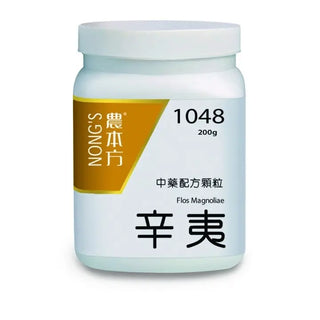
Traditional TCM Properties

Acrid; WarmLungStomach

Traditional Functions

Dispels wind, opens nose. Apply to headache, persistent turbid nasal discharge, nasal obstruction, toothache.

How Xin Yi Is Used in TCM

In the Chinese materia medica, Xin Yi is classified among the Exterior-releasing herbs. It appears in 4 classical formulas in our library.

Formulas containing Xin Yi are traditionally used for:

Nasal CongestionHeadacheAllergic RhinitisDry Mouth & ThroatFever

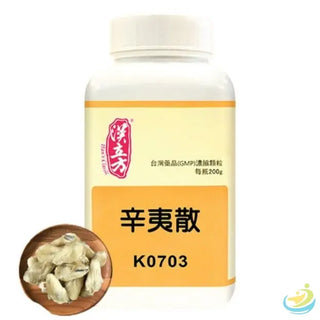
Classical Formulas Containing Xin Yi

Frequently Asked Questions

What is Xin Yi? Are Cang Er Zi, Bai Zhi and garden magnolia flowers the same?
Official Xin Yi (辛夷) is the dried flower bud of Magnolia biondii, Magnolia denudata or Magnolia sprengeri. The pharmacopoeial name is Magnoliae Flos. Cang Er Zi is acrid-bitter-warm and toxic: disperses wind-cold, opens the nasal orifices and dispels wind-damp. Bai Zhi is acrid-warm: releases the exterior, stops pain, opens the nose, dries damp and checks vaginal discharge. Open garden magnolia petals are not equal-weight pharmacopoeial buds. Write Xin Yi and decoct in a bag. Use caution in yin-vacuity fire flaming upward.
What are the TCM properties and traditional uses of Xin Yi?
According to the Chinese Pharmacopoeia, Xin Yi is acrid and warm, enters the Lung and Stomach channels, and acts to disperse wind-cold and open the nasal orifices. It is used for wind-cold headache, nasal congestion with runny nose, allergic rhinitis and deep-source nasal congestion. Acrid-warm and upward-reaching, it suits wind-cold nasal blockage and deep-source congestion—not yin-vacuity fire, or qi vacuity with blocked orifices but no cold.
Why must Xin Yi be decocted in a bag? Can it be steeped as tea?
The buds are densely hairy; loose hairs float and irritate the throat. The pharmacopoeia requires decoction in a cloth bag. Externally an appropriate amount may be powdered or used in professionally prepared nose drops. Do not steep unwrapped whole buds as a daily “nose-opening tea.”
Read the complete guide →

Learn More About Xin Yi

Explore our in-depth article covering the traditional uses, properties, functions, and TCM context of Xin Yi.

Read the Xin Yi Guide →

Medical Disclaimer — This article is provided for educational purposes only and describes traditional Chinese medicine concepts. It is not medical advice, and it is not intended to diagnose, treat, cure or prevent any disease. Always consult a qualified practitioner before using any herb, particularly if you are pregnant, nursing, taking medication or managing a diagnosed condition.

Login

Forgot your password?

Don't have an account yet?
Create account