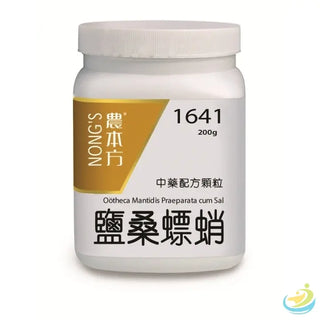
Zoological substancesAstringentMantidis Ootheca (salt-processed)

Yan Sang Piao Xiao (Salt-processed Mantis Egg-case)

A practical guide to Yan Sang Piao Xiao: what it is, how Traditional Chinese Medicine uses it, the classical formulas it appears in, and who should be careful with it.

View Herb Profile →

Last reviewed Oct 28, 2026

Quick Facts

Latin NameMantidis Ootheca (salt-processed)
Chinese Name & Pinyin 鹽桑螵蛸 · Yan Sang Piao Xiao
Medicinal PartZoological substances
The itemYan Sang Piao Xiao is the salt-processed dried egg case of the praying mantis. Hai Piao Xiao (cuttlefish bone) and other egg cases are not this drug.
Nature and channelsWarm, sweet and salty. Enters the Liver and Kidney. Warm sweet-salty supplements kidney yang, astringes and secures the lower burner.
Pharmacopoeia lineSupplements the kidney and supports yang; astringes and secures. Used for frequent urination at night, bed-wetting, seminal emission, and weak sexual function.
Pattern cuesNight urination. Bed-wetting. Seminal emission. Turbid dribbling. Cold lower back and knees. Fear of cold.
In this articleYan Sang Piao Xiao versus Hai Piao Xiao. Supplementing kidney yang versus securing and curbing acid. Why yin-fire and damp-heat should skip it. Home porridge.

What Is Yan Sang Piao Xiao?

Yan Sang Piao Xiao (盐桑螵蛸; Yán Sāng Piāo Xiāo; Latin: Ootheca Mantidis; English: salt-processed mantis egg case) is the dried egg case of the praying mantis — the foamy spongy capsule the mantis cements to mulberry twigs, salt-processed and toasted, the small tan nugget herbalists reach for when the body leaks. It is warm, sweet and salty, enters the Liver and Kidney channels, and its core actions are to supplement the kidney and support yang, and to astringe and secure. It is the quiet keeper of what the lower body should hold. The usual amount is 5–10 g in a decoction. It soaks 30 minutes before cooking; no special first, last, or wrapped step. It is not swallowed raw or as a snack.

It is not Hai Piao Xiao. Cuttlefish bone is slightly warm, salty and astringent — it secures, stops discharge, and curbs acid, better for excess vaginal discharge, stomach acid, and bleeding; this mantis egg case is warm, sweet and salty — it supplements kidney yang and secures the lower burner, better for weak sexual function and bed-wetting. It is not a hot fire-tonic; it is a gentle warm-and-hold. In yin-deficiency with fire — night sweats, a dry mouth, a red tongue — or in damp-heat pouring downward, using it on your own is a poor match. Bed-wetting and leaking in a child or the elderly need a clinic first. Do not take it yourself for a long time.

It is used most often for three patterns:

  • Frequent urination at night, bed-wetting, urine that will not hold, turbid dribbling — the bladder not secured
  • Sexual weakness, seminal emission, cold lower back and knees, fear of cold — kidney yang insufficient
  • Yin-deficiency with fire, or damp-heat pouring downward — seek care / skip it

Warm, sweet, and salty, it is not a daily "bladder-nut" to keep eating. Securing when there is no leak, or in damp-heat, locks the pathogen in instead of helping.

When irregular routines and strain thin the kidney qi, the bladder loses its hold — nights bring repeated trips, the urine leaks, the essence slips — and the body needs a gentle warm-and-secure, not a drain. Yan Sang Piao Xiao is warm, sweet, and salty. It supplements the kidney, supports yang, and secures the lower burner, which is why it appears in Sang Piao Xiao San (Mantis Egg-Case Powder)–type formulas. It holds more than it flushes. In yin-deficiency with fire, or damp-heat, more makes it worse.

Yan Sang Piao Xiao is not a catch-all urine or emission keeper. In yin-deficiency with fire, in damp-heat, in pregnancy, or with no leak, using it alone is a poor match. Whether it belongs in a formula, and at what dose, should be decided by a licensed Chinese medicine practitioner after pattern diagnosis.

Yan Sang Piao Xiao

Yan Sang Piao Xiao: Materia Medica Profile

Identification & Quality Standard

Mantidis Ootheca (salt-processed)

Botanical Origin

The dried egg-case of Tenodera sinensis Saussure, Statilia maculata (Thunberg), or Hierodula patellifera (Serville) (Mantidae).

Production Regions

Primarily produced in the Chinese provinces of Guangxi, Yunnan, Hubei, Hunan, Hebei, Liaoning.

Quality Requirements

Superior medicinal material is large, yellowish, light, and tough.

Macroscopic Features

Short cylindrical or semi-elliptical, 6~10cm long, 1~2cm thick. Externally yellowish-brown or tan, with parallel transverse striations. Light, slightly tough; fractured surface is membranous, with many small chambers arranged in radial pattern, each containing a light yellowish egg. Faint fishy odor, taste slightly salty.

Main Regions and Quality Identification

Classic texts and trade experience favor cases from several northern provinces, but quality still depends on variety, harvest time, processing, and storage. Yan Sang Piao Xiao is cylindrical, light yellowish-brown to yellow-brown, with irregular cross grooves and raised net-like lines, light and crisp, breaking into a sponge-like outer layer and radiating inner chambers each holding a tiny egg. The salt form carries a light salt smell; the raw case is slightly fishy. The common look-alikes are egg cases of other insects — such as locust egg cases — different in form, texture, and smell; check carefully.

Traditional Properties & Historical Lineage

Nature, Flavour & Channel Tropism

Sweet, Salty; NeutralLiverKidney

1. Records in Classic Materia Medica

  • Shen Nong Ben Cao Jing: lists it in the upper class — "is used for injury from within, benefiting the essence, and regulating urination."
  • Ming Yi Bie Lu: adds "for deficiency and loss in men, seminal emission in dreams, and bed-wetting."
  • Ben Cao Gang Mu: notes it is "specially for securing — widely used in formulas for kidney deficiency, seminal loss in dreams, and bed-wetting."

Salt-processing is said to guide the action into the Kidney, strengthening the kidney-supporting and securing sides — better for lower-burner deficiency.

2. How Views of Its Nature Changed

Some doctors leaned on supplementing the liver-kidney — for kidney-deficiency emission and bed-wetting; others on the astringent, securing side — holding the bladder and kidney against frequent urine; some drew the line — better for lower-burner deficiency-cold, while yin-deficiency with fire and damp-heat pouring downward should be cautious, lest the securing trap the pathogen.

Yan Sang Piao Xiao

Core Efficacies & Traditional Applications

Traditional Functions

Secures essence and reduces urination, supplements kidney and assists yang; salt-processed form guides herb to kidney.

1. Main Use 1: Supplementing the Kidney and Supporting Yang

(1) Traditional action: supplementing kidney yang and easing lower-burner deficiency. (2) Typical patterns: kidney-deficiency sexual weakness and seminal emission, cold lower back and knees, fear of cold. (3) Usual pairings: Lu Rong (deer velvet) and Ba Ji Tian (morinda root) to strengthen the kidney-supporting action. (4) Not for self-use: yin-deficiency with fire or damp-heat pouring downward — emission and frequent urine with inner heat — the warm case can feed the inner heat.

2. Main Use 2: Astringing and Securing

(1) Traditional action: securing the lower-burner fluids. (2) Typical patterns: kidney qi not holding — frequent urination at night, bed-wetting, urine incontinence, turbid dribbling. (3) Usual pairings: Long Gu (dragon bone) and Mu Li (oyster shell) to strengthen the securing. (4) Not for self-use: these are lower-burner deficiency — a practitioner should guide the use, lest self-taking trap pathogen inside.

3. A Classic Pairing

Yan Sang Piao Xiao pairs classically with Yi Zhi Ren: the egg case supplements the kidney and secures the lower burner — for emission and bed-wetting; the black cardamom warms the spleen and shrinks the bladder — for cold-spleen drooling and frequent urine. Together they warm the kidney-spleen and hold the fluids, for spleen-kidney dual deficiency with frequent night urine and bed-wetting. This pair belongs to a practitioner's pattern diagnosis — no casual self-pairing.

Yan Sang Piao Xiao

Modern Research

Modern research offers useful context, but Traditional Chinese Medicine prescribes on whole-pattern diagnosis rather than isolated compounds.

1. Main Chemical Constituents

Detected in the egg case are proteins, amino acids, phospholipids, polysaccharides, and trace minerals such as calcium, magnesium, and iron — natural substances, not direct pharmacology. In vitro, some components mildly curb certain bacteria — under specific lab conditions, not equal to human effects. In animals, extracts appear to affect urination frequency in mice and somewhat adjust reproductive markers — animal-condition results, not transferable to people. Human studies are still few; no clear clinical conclusion exists.

2. Current Research Directions

Current work centers on separating and identifying the components and their effects on animal physiology. Some components show antioxidant activity — clearing free radicals in vitro — still needing deeper study. Research is exploring potential roles for the urinary and reproductive systems, but human verification of real effects is still needed.

3. Limitations of Current Research

  • Lab results are not clinical efficacy — component effects and animal results do not prove equal human effects.
  • Extracts are not decoction pieces — purified components differ in dose, form, and absorption from the piece.
  • Doses and preparations vary between studies — results are hard to compare.
  • One component does not define the whole herb — the case acts as a team of constituents.

Yan Sang Piao Xiao

Comparing Similar Herbs

1. What They Share

  • Both astringe and secure — for bed-wetting and emission.
  • Both appear in similar lower-burner formulas and food remedies.
  • Both need constitution and dose care — no casual use.

2. Key Differences

Nature and flavor: Yan Sang Piao Xiao is warm, sweet and salty, entering the Liver and Kidney — leaning to supplementing kidney yang; Hai Piao Xiao is slightly warm, salty and astringent, entering the Liver and Kidney — leaning to securing, stopping discharge, and curbing acid. Focus: Yan Sang Piao Xiao supplements kidney yang — for sexual weakness and emission; Hai Piao Xiao secures — for excess vaginal discharge, stomach acid pain, and bleeding. Tendency: Yan Sang Piao Xiao is an astringent, descending piece — building kidney qi and its holding power; Hai Piao Xiao mainly holds fluids and stops loss. Best fit: Yan Sang Piao Xiao for clear kidney deficiency — cold lower back, fear of cold, emission; Hai Piao Xiao for clear fluid loss — thin discharge, stomach acid, blood in stools or uterine bleeding. Who should avoid: Yan Sang Piao Xiao — yin-deficiency with fire and damp-heat pouring downward; Hai Piao Xiao — yin-deficiency with more heat, where the securing can deepen the fluid loss. Where you meet them: Yan Sang Piao Xiao in kidney-securing formulas like Sang Piao Xiao San; Hai Piao Xiao in securing formulas like Wu Bei San for stomach acid and discharge.

3. One-Line Takeaway

In short, Yan Sang Piao Xiao supplements the kidney and supports yang; Hai Piao Xiao secures and curbs acid. Both can serve lower-burner securing — but they are not stand-ins for each other.

Yan Sang Piao Xiao

Classical Formulas Containing Yan Sang Piao Xiao

Formula vs. Single Herb

A formula is a coordinated team — different herbs cover several mechanisms, checking each other's bias; a single herb cannot copy a full formula's effect. The doses and pairings are designed as a whole — a herb that works in a formula does not automatically work the same way alone. Do not self-formulate from web articles.

Diet & Daily Home Use

1. Home Porridge

Example — Yan Sang Piao Xiao and Yi Zhi Ren porridge: Yan Sang Piao Xiao 5 g, Yi Zhi Ren 5 g, rice 50 g, sugar to taste — decoct the two herbs 20 minutes, strain, cook the rice in the liquid, sweeten lightly. Fit: spleen-kidney dual deficiency — frequent night urine and bed-wetting — for adults' gentle daily care. Not for: yin-deficiency with fire or damp-heat pouring downward — the warm case can feed the inner heat. Frequency: 1–2 times a week, no long unbroken stretches.

2. Decoction and Processing Differences

The raw case leans to clearing heat and dispersing lumps; the salt form to supplementing the kidney and securing — home use should pick the salt form, never the raw. The case is hard — soak 30 minutes before cooking; no special first, last, or wrapped step, ordinary decoction. Different forms cannot be converted directly — a piece dose is not a ready-made-medicine dose.

3. Dosage and How Long to Use

The classic range is 5–10 g; food-use amounts should stay below the medicinal dose — no more than about 5 g per serving — to avoid overuse. Food use is light support; medicinal doses are larger and follow pattern diagnosis. No long continuous use — no more than 2 weeks straight; for longer care, consult a practitioner or pharmacist.

Yan Sang Piao Xiao

Contraindications & Safety Warnings

1. Who Should Avoid It

Yin-deficiency with fire — night sweats, a dry mouth, a red tongue with little coat — the warm case can feed the inner heat; damp-heat pouring downward — scanty dark urine, urgent frequent urine, a yellow greasy coat — the securing can trap the damp-heat; pregnancy and nursing — no self-use of herbs; children — developing organs, practitioner-guided; liver or kidney impairment — weaker metabolism, use may add burden; allergy to mantis egg case or related insect products — avoid.

2. Interactions and Diet Notes

The case may interact with some medicines — anticoagulant, blood-pressure, blood-sugar, and sedative types; anyone on them should consult a doctor or pharmacist first. No blanket "food clash" with ordinary foods is established, but herbs can interact with specific medicines — check with a professional before combining. Keep the diet light — heavy spicy and greasy food can blunt the absorption and effect.

3. Side Effects and Overuse

Reactions are mainly "heat" signs — a dry mouth, mouth sores, bound stools — more likely in yin-deficiency with fire. Stop and seek care at once for marked discomfort, an allergic reaction, persistent vomiting, trouble breathing, confusion, or a rapid worsening of symptoms.

Frequently Asked Questions About Yan Sang Piao Xiao

What is Yan Sangpiaoxiao? Is it the same as raw Sangpiaoxiao or Haipiaoxiao?
Yan Sangpiaoxiao is the salt-fried dried egg case of Tenodera sinensis, Statilia maculata or Hierodula patellifera, Latin name Mantidis Oötheca Praeparata. It is a common Chinese medicine centered on securing essence and reducing urination, and tonifying the kidney and assisting yang. Raw Sangpiaoxiao secures essence and reduces urination while tonifying the kidney. Haipiaoxiao astringes and stops bleeding while controlling acid. They cannot be used interchangeably in equal amounts. Prescribe as Yan Sangpiaoxiao. Caution in yin deficiency with fire effulgence.
What are the composition and effects of Yan Sangpiaoxiao?
Pharmacopoeial name Yan Sangpiaoxiao, Latin Tenodera sinensis Saussure, Statilia maculata (Thunberg) or Hierodula patellifera (Serville). Sweet and salty in taste, neutral in nature, enters the Liver and Kidney meridians. Functions to secure essence and reduce urination, and tonify the kidney and assist yang. Used for seminal emission and slippery essence, enuresis and frequent urination, and turbid urine. Secures essence and reduces urination.
How to choose between raw and processed? Can raw Sangpiaoxiao replace it?
Egg case is salt-fried. Raw product emphasizes tonifying the kidney; salt-processing enhances entering the kidney and securing essence, and cannot replace it in equal amounts. Commercial products are standardized; do not adjust arbitrarily.
What is the dosage of Yan Sangpiaoxiao? Can it be used daily as an essence-securing tea?
Decoction, 5-10g. Modern use requires physician-determined dosage. It is not a year-round "Yan Sangpiaoxiao tea." Yin deficiency with fire effulgence will be further injured by prolonged use. Seminal emission requires short-term, physician-determined dosage and cannot replace evaluation.
What are the contraindications of Yan Sangpiaoxiao? Can pregnant women use it?
Not suitable for yin deficiency with fire effulgence or bladder heat. Pregnant women require physician evaluation. Stop if dry mouth or irritability with heat occur. Seek immediate medical care for severe seminal emission or high fever.
Can Yan Sangpiaoxiao secure essence, reduce urination, and assist yang?
It can assist seminal emission and slippery essence, enuresis and frequent urination, and turbid urine. It secures essence and reduces urination, and tonifies the kidney and assists yang, but is not a specific remedy for all seminal emission or all frequent urination.
Can Yan Sangpiaoxiao be taken daily as an essence-securing or urination-reducing tea?
Kidney deficiency seminal emission can be used short-term in formulas; yin deficiency with fire effulgence will be further injured. The idea that "Yan Sangpiaoxiao must secure essence" cannot replace evaluation. Securing essence and reducing urination requires physician-determined formulation and dosage.
How to choose between Yan Sangpiaoxiao, raw Sangpiaoxiao, Haipiaoxiao, Yizhiren, and Jinyingzi?
Yan Sangpiaoxiao secures essence and tonifies the kidney, suited to seminal emission. Raw Sangpiaoxiao secures essence and tonifies the kidney. Haipiaoxiao astringes and stops bleeding. Yizhiren warms the kidney and secures essence. Jinyingzi secures essence and astringes the intestines. Choose Yan Sangpiaoxiao for securing essence; raw Sangpiaoxiao for tonifying the kidney; Haipiaoxiao for stopping bleeding; Yizhiren for warming the kidney; Jinyingzi for astringing the intestines. Pattern differentiation applies, but large doses of Yan Sangpiaoxiao are contraindicated in yin deficiency with fire effulgence.
How is Yan Sangpiaoxiao commonly modified? What is a representative usage?
Modifications depend on the pattern. Add Jinyingzi for seminal emission; add Yizhiren for frequent urination. Specify Yan Sangpiaoxiao; do not substitute raw Sangpiaoxiao in equal amounts for salt-processing.
How to select and store Yan Sangpiaoxiao?
Choose regular Chinese medicinal materials with intact salt-fried egg cases. Discard if moldy, damp, or abnormal in odor. Store in a dry place. Purchase "Yan Sangpiaoxiao"; do not substitute raw Sangpiaoxiao or Haipiaoxiao in equal amounts for securing essence, reducing urination, and assisting yang.

Medical Disclaimer — This article is provided for educational purposes only and describes traditional Chinese medicine concepts. It is not medical advice, and it is not intended to diagnose, treat, cure or prevent any disease. Always consult a qualified practitioner before using any herb, particularly if you are pregnant, nursing, taking medication or managing a diagnosed condition.

More Chinese Herbs

Login

Forgot your password?

Don't have an account yet?
Create account

Yan Sang Piao Xiao (Salt-processed Mantis Egg-case): Secures essence, reduces urination, tonifies the kidney, and assists yang