Si Wu Tang: Classic TCM Formula for Nourishing and Moving Blood
Si Wu Tang (四物汤), known in English as Four Substances Decoction, is one of the most fundamental and widely used classical formulas in Traditional Chinese Medicine for nourishing and moving Blood. It is particularly indicated for Blood deficiency and Blood stasis, especially in gynecological conditions such as irregular menstruation, dysmenorrhea (painful periods), amenorrhea (absent periods), and postpartum recovery. In modern clinical practice, Si Wu Tang is used as a base formula for a wide range of Blood-related disorders, including anemia, menstrual irregularities, and general Blood deficiency symptoms like pale complexion, dizziness, and fatigue. By combining strong Blood nourishment with gentle Blood movement, it addresses both deficiency and stasis, making it highly effective for the common clinical pattern of Blood deficiency with concurrent stasis.

I. Origins and History
1. The Legend of Siwu Tang's Origin
The origin of Siwu Tang comes with a rich store of legend. One account holds that it was created by an ancient physician skilled in the medical arts. Through prolonged clinical practice, this physician observed that women, at different physiological stages such as menstruation, pregnancy, and the postpartum period, often experienced various qi-blood related issues. To regulate women's health, he researched and experimented repeatedly, skilfully combining four herbs, and eventually formed the classical formula known as Siwu Tang. Though the legend carries an air of mystery, it also reflects, from another angle, the long historical origins of Siwu Tang in regulating women's health.
2. Historical Records
Siwu Tang was first recorded in the *Xianshou Lishang Xuduan Mifang* (Secret Formulas for Bone-Setting and Trauma, Transmitted by an Immortal), written by the Tang dynasty physician Lin Daoren, where it was originally used to treat pain from traumatic injury with blood stasis. By the Song dynasty, the application of Siwu Tang gradually expanded into the gynaecological field, becoming a commonly used formula for regulating women's irregular menstruation, dysmenorrhoea, and related disorders. Chen Ziming's *Furen Liangfang Daquan* (Complete Compendium of Effective Formulas for Women) provided a detailed exposition of Siwu Tang's application in treating gynaecological disorders, emphasising its action of nourishing blood and regulating menstruation. Since then, Siwu Tang has continually developed and been refined through the clinical practice of physicians across successive generations, becoming one of the core formulas in the field of Chinese medicine gynaecology, widely applied in the treatment of various gynaecological disorders, and passed down to the present day.

II. Herb Composition (Sovereign, Minister, Assistant, Envoy)
1. Shudihuang — Chief Herb
Shudihuang (Prepared Rehmannia Root) is the chief herb in Siwu Tang. It is sweet in flavour, slightly warm in nature, and enters the liver and kidney channels. Shudihuang has the actions of nourishing yin, tonifying blood, and enriching essence and marrow. After processing, Shudihuang has a moist, rich texture, able to greatly tonify liver-kidney yin-blood, providing an abundant material foundation for the generation of yin-blood throughout the body. In women's physiological processes, the generation and nourishment of menstrual blood depends on sufficient yin-blood, and Shudihuang plays a key role in this regard, making it the core herb through which Siwu Tang's action of nourishing yin and blood is achieved.
2. Danggui — Deputy Herb
Danggui (Angelica Root) is sweet and acrid in flavour, warm in nature, and enters the liver, heart, and spleen channels. It has the actions of tonifying and activating blood, regulating menstruation and relieving pain, and moistening the intestines to unblock bowel movements. Danggui both tonifies blood and activates blood — tonifying within movement and movement within tonification — providing good regulatory benefit for irregular menstruation, amenorrhoea, and dysmenorrhoea in women caused by blood deficiency. In Siwu Tang, Danggui assists Shudihuang in strengthening the blood-tonifying action, while also activating blood and unblocking the menses, so that tonification does not lead to stagnation, helping qi and blood to flow smoothly, making it an important deputy herb for regulating women's qi and blood.
3. Baishao — Assistant Herb
Baishao (White Peony Root) is bitter and sour in flavour, slightly cold in nature, and enters the liver and spleen channels. Baishao has the actions of nourishing blood and regulating menstruation, astringing yin to stop sweating, softening the liver to relieve pain, and calming hyperactive liver yang. In Siwu Tang, Baishao on the one hand assists Shudihuang and Danggui in strengthening the blood-nourishing action, and on the other hand restrains Shudihuang's cloying, rich nature, allowing the formula to tonify without causing stagnation. At the same time, Baishao also softens the liver and relieves pain, providing relief for symptoms such as hypochondriac pain and menstrual abdominal pain caused by liver depression with blood deficiency in women, playing an assisting and harmonising role.
4. Chuanxiong — Envoy Herb
Chuanxiong (Szechuan Lovage Rhizome) is acrid in flavour, warm in nature, and enters the liver, gallbladder, and pericardium channels. Chuanxiong has the actions of activating blood, moving qi, dispelling wind, and relieving pain. It is acrid and fragrant, dispersing widely — rising to the head and eyes, descending to the sea of blood, and reaching outward to the limbs and joints — earning it the description "the qi herb within the blood." In Siwu Tang, Chuanxiong moves qi and activates blood, allowing the whole formula to tonify blood without causing stagnation, and move blood without breaking it, guiding the other herbs directly to the site of disease and exerting its action of regulating menstruation and relieving pain, making it the envoy herb of the formula.

III. Pathomechanism, Actions, and Indications
1. Pathomechanism (Constitution)
The pathomechanism targeted by Siwu Tang is mainly blood deficiency with sluggish blood movement. Due to their physiological characteristics — such as menstruation, pregnancy, and childbirth — women readily develop yin-blood deficiency. When yin-blood is insufficient, it cannot nourish the organs, channels, muscles, and other tissues, giving rise to various discomforts. At the same time, blood deficiency can also lead to qi stagnation and blood stasis, causing sluggish blood movement, which in turn gives rise to disorders such as irregular menstruation and dysmenorrhoea.
2. Actions
The main action of Siwu Tang is to tonify and regulate blood. Through the yin-nourishing, blood-tonifying actions of Shudihuang, Danggui, and Baishao, the insufficiency of the body's yin-blood is replenished, allowing the organs and channels to be fully nourished. Chuanxiong's action of moving qi and activating blood helps promote blood circulation, allowing qi and blood to flow smoothly. The whole formula's combination both tonifies blood and moves blood, achieving the effect of tonifying blood without causing stagnation, and moving blood without damaging it, thereby realising the action of tonifying and regulating blood.
3. Indications
Siwu Tang mainly treats the pattern of ying-blood deficiency with stagnation. Common symptoms include dizziness, palpitations and insomnia, a lacklustre complexion, irregular menstruation in women, scanty flow or amenorrhoea, periumbilical and abdominal pain, or even hardened masses and lumps, a pale tongue, and a wiry, thin or thin, choppy pulse. These symptoms are mostly related to blood deficiency and sluggish blood movement in women; through its action of tonifying and regulating blood, Siwu Tang can effectively improve these symptoms and restore the balance of qi and blood in the female body.

IV. Formula Analysis
1. Tonifying Blood and Nourishing Yin
Shudihuang is an essential herb for nourishing yin and tonifying blood; its yin-nourishing power nourishes liver-kidney yin, providing a source for the generation of yin-blood throughout the body. Danggui tonifies and activates blood, working synergistically with Shudihuang to strengthen the blood-tonifying effect. Baishao nourishes blood and astringes yin, assisting Shudihuang and Danggui in further nourishing yin and blood, allowing yin-blood to be sufficient and nourish the whole body, improving blood-deficiency symptoms.
2. Moving Qi and Activating Blood
Chuanxiong is acrid, fragrant, and freely moving, excelling at moving qi and activating blood. It unblocks qi and blood, allowing blood to flow smoothly through the channels. Adding Chuanxiong's qi-moving, blood-activating action on the basis of blood tonification prevents the blood-tonifying herbs from causing blood stagnation, ensuring the normal movement of qi and blood, so that tonification does not cause stagnation and movement does not cause damage, thereby achieving the goal of tonifying and regulating blood.
3. Characteristics of the Combination
Siwu Tang's combination is characterised by a balance of movement and stillness, with blood tonification and blood movement combined. Shudihuang, Danggui, and Baishao mainly tonify blood and nourish yin, with relatively "still" properties; Chuanxiong mainly moves qi and activates blood, with relatively "moving" properties. This balance of movement and stillness complements each other, allowing the formula to both nourish yin-blood and promote qi-blood movement, making it suitable for a variety of disorders involving blood deficiency with concurrent blood stasis.

V. Comparison with Related Formulas
1. Bazhen Tang
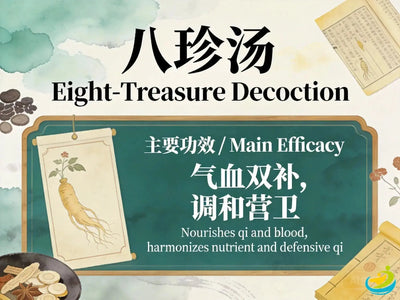
Bazhen Tang is formed by adding four qi-tonifying herbs — Renshen (Ginseng), Baizhu (Atractylodes Rhizome), Fuling (Poria), and Gancao (Licorice) — to Siwu Tang, forming a formula that tonifies both qi and blood. Compared with Siwu Tang, Bazhen Tang places greater emphasis on conditions of combined qi-blood deficiency. Siwu Tang mainly targets conditions predominated by blood deficiency, while Bazhen Tang, while tonifying blood, adds qi-tonifying herbs, strengthening the action of tonifying qi to generate blood, making it suitable for patients with more pronounced qi-blood insufficiency, presenting with symptoms such as a sallow complexion, dizziness, and shortness of breath with fatigue.
2. Guipi Tang
Guipi Tang's main actions are to boost qi and tonify blood, and strengthen the spleen and nourish the heart. Its difference from Siwu Tang lies in that Guipi Tang places greater emphasis on regulating heart-spleen deficiency. Besides blood-tonifying herbs, Guipi Tang also includes a substantial number of spleen-strengthening, heart-nourishing herbs, such as Renshen, Baizhu, Huangqi (Astragalus Root), Longyanrou (Longan Fruit), and Suanzaoren (Sour Jujube Seed). It is suited to symptoms such as palpitations and fearful throbbing, insomnia and forgetfulness, poor appetite and fatigue, and a sallow complexion caused by heart-spleen deficiency, differing from the pattern of ying-blood deficiency with stagnation targeted by Siwu Tang.
3. Jiao'ai Tang
Jiao'ai Tang is formed by adding Ejiao (Donkey-Hide Gelatin), Aiye (Mugwort Leaf), and Gancao to Siwu Tang. Building on tonifying and regulating blood, Jiao'ai Tang places greater emphasis on nourishing blood, stopping bleeding, regulating menstruation, and calming the fetus. Ejiao has the action of tonifying blood and stopping bleeding, Aiye warms the channels and stops bleeding while dispersing cold and regulating menstruation, and Gancao harmonises the other herbs. This formula is commonly used to treat conditions such as uterine bleeding, excessive menstrual flow with continuous spotting, unresolved postpartum bleeding, bleeding during pregnancy, and abdominal pain caused by deficiency and cold of the chong and ren channels with blood deficiency in women, differing from Siwu Tang's simpler action of tonifying and regulating blood.

VI. Clinical Applications
1. Irregular Menstruation
Siwu Tang is a commonly used formula for treating irregular menstruation. For blood-deficiency type irregular menstruation, presenting with scanty menstrual flow, pale colour, and thin consistency, accompanied by symptoms such as dizziness and palpitations with insomnia, Siwu Tang can tonify blood and regulate menstruation, restoring the menstrual cycle to normal. For delayed menstruation and dysmenorrhoea caused by sluggish blood movement, Siwu Tang, through its blood-activating, qi-moving action, promotes the expulsion of menstrual blood, relieves pain, and regulates the menstrual cycle.
2. Amenorrhoea
Siwu Tang also has a certain therapeutic effect for amenorrhoea caused by blood deficiency or blood stasis. Amenorrhoea caused by blood deficiency is mostly due to an empty sea of blood, with no blood available to descend; Siwu Tang can tonify and nourish blood, filling the sea of blood and promoting the onset of menstruation. Amenorrhoea caused by blood stasis requires the blood-activating power of Chuanxiong within Siwu Tang, to break up blood stasis, unblock the channels, and restore menstruation.
3. Postpartum Conditioning
Postpartum women have weakened bodies and insufficient qi and blood. Siwu Tang can be used postpartum to tonify and nourish blood, promoting bodily recovery. It can improve blood-deficiency symptoms such as postpartum dizziness and a pale complexion, strengthen the body's resistance, help the mother recover strength more quickly, and nourish the body, providing a good foundation for postpartum recovery.

VII. Clinical Modifications for Siwu Tang
1. Pronounced Blood Deficiency
If blood-deficiency symptoms are relatively severe, the dosages of Shudihuang and Danggui may be increased to strengthen the blood-tonifying action. Ejiao and Gouqizi (Goji Berry) may also be added as yin-nourishing, blood-tonifying herbs to further nourish yin-blood and improve the blood-deficiency condition.
2. Predominant Blood Stasis
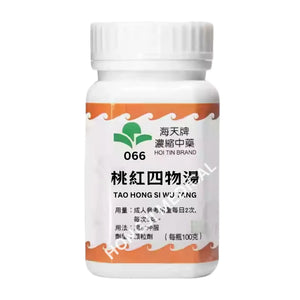
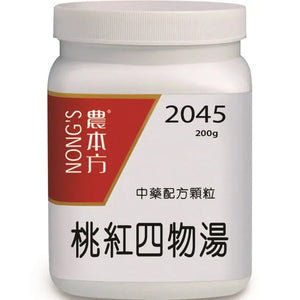
When blood-stasis symptoms are pronounced, such as severe dysmenorrhoea with dark purple menstrual blood and clots, the dosage of Chuanxiong may be increased, and blood-activating, stasis-resolving herbs such as Taoren (Peach Kernel) and Honghua (Safflower) may be added, strengthening the effect of activating blood, unblocking the menses, resolving stasis, and relieving pain.
3. Qi Stagnation with Discomfort
If accompanied by qi-stagnation symptoms, such as chest and hypochondriac fullness and breast distension and pain, liver-soothing, qi-regulating herbs such as Chaihu (Bupleurum Root) and Xiangfu (Cyperus Rhizome) may be added, to move qi and resolve depression, allowing qi and blood to move more smoothly, working synergistically with Siwu Tang.
4. Concurrent Qi Deficiency
For concurrent qi-deficiency symptoms, such as shortness of breath with fatigue and spontaneous sweating, qi-tonifying herbs such as Renshen and Huangqi may be added, to strengthen the qi-tonifying action, tonifying both qi and blood and improving the overall condition of the body.

VIII. Dosage and Preparation (Traditional Method and Modern Concentrated Granules)
1. Traditional Method
The traditional method for Siwu Tang uses Shudihuang, Danggui, Baishao, and Chuanxiong in equal portions; generally, the dosage per dose is Shudihuang 12g, Danggui 10g, Baishao 10g, and Chuanxiong 8g. The herbs are washed, soaked in water for around 30 minutes, then simmered slowly over a low flame for 30–40 minutes, yielding about 200–300 ml of liquid, taken warm in two divided doses. This traditional decoction method allows the active constituents of the herbs to be fully extracted, but is relatively laborious and requires time and effort.
2. Modern Concentrated Granules
With the development of modern pharmaceutical technology, a modern concentrated granule form of Siwu Tang has emerged. This dosage form is produced by extracting and concentrating the herbs in Siwu Tang into granules, which can be taken by simply dissolving in boiled water. The dosage per serving generally depends on the product instructions of different manufacturers, and is typically convenient and quick. The modern concentrated granule form preserves the active constituents of the herbs and is convenient to take, suiting the fast pace of modern life, though it may be somewhat more expensive than traditional herb slices.

IX. Precautions and Contraindications
1. Use with Caution in Those with a Dry-Heat Constitution
Siwu Tang has a warming nature; for those with a dry-heat constitution — such as individuals prone to dry mouth and throat, sore swollen throat, and dry, hard stools — taking it may aggravate internal dry-heat symptoms, causing discomfort. Therefore, such individuals should use Siwu Tang with caution, or make appropriate adjustments according to their own circumstances under a physician's guidance.
2. Precautions During Menstruation and Pregnancy
Women with excessive menstrual flow during their period should avoid taking Siwu Tang, to prevent further increasing menstrual flow. During pregnancy, especially the early stages, the blood-activating herbs in Siwu Tang may affect the fetus, and it is generally not recommended for use. If special circumstances require its use, it must be carried out under a physician's strict guidance.
3. Dietary Precautions
While taking Siwu Tang, spicy, greasy, raw, and cold irritating foods should be avoided. These foods may affect the absorption and efficacy of the herbs, and are also unfavourable for recovery. A light diet should be maintained, with more nutritious foods such as lean meat, eggs, legumes, vegetables, and fruit, to promote recovery.
4. Individual Variation
Each person's constitution and condition differ, and responses to Siwu Tang may also vary. If discomfort occurs during treatment, such as abdominal distension, diarrhoea, nausea, or vomiting, the medication should be stopped immediately and medical attention sought promptly, with the treatment plan adjusted according to the physician's advice.

X. Modern Research
1. Effects on the Blood System
Siwu Tang is a classical Chinese medicine formula for tonifying blood, composed of Danggui, Chuanxiong, Baishao, and other herbs, with the action of nourishing and activating blood. It is suited for women with a qi-deficient constitution to take after their period or during menstruation to strengthen physical stamina. Before use as a medicinal food preparation, it is advisable to consult a TCM practitioner for pattern-based guidance.
Modern research shows that Siwu Tang can promote the proliferation and differentiation of haematopoietic stem cells, increasing the count of peripheral red blood cells, white blood cells, and platelets, and strengthening the body's haematopoietic function. Its various active constituents, such as ferulic acid and paeoniflorin, may promote the generation of bone marrow haematopoietic cells by regulating haematopoiesis-related signalling pathways, thereby improving blood-deficiency symptoms.
2. Effects on the Cardiovascular System
Siwu Tang has a certain regulatory effect on the cardiovascular system. It can dilate blood vessels, reduce vascular resistance, increase coronary flow, and improve myocardial ischaemia. It can also regulate lipid metabolism, reduce blood viscosity, and reduce the risk of thrombus formation, offering potential value for the prevention and treatment of cardiovascular disease.
3. Regulation of the Immune System
Research has found that Siwu Tang can strengthen the body's immune function. It can promote the proliferation and differentiation of lymphocytes, raising the level of the body's cellular and humoral immunity, strengthening the body's resistance, and helping to prevent and treat certain immune-related diseases.
4. Other Actions
Siwu Tang also shows a degree of activity in antioxidant, anti-inflammatory, and anti-tumour effects. Its various antioxidant constituents can clear free radicals from the body, reducing oxidative damage; its anti-inflammatory action helps reduce inflammatory response, providing adjunctive therapeutic benefit for certain inflammatory diseases; in anti-tumour research, Siwu Tang has also been found to potentially exert an anti-cancer effect through mechanisms such as regulating the cell cycle and inducing tumour cell apoptosis, though these studies remain at an exploratory stage and require further in-depth research and verification.
As a classical Chinese medicine formula, Siwu Tang, having been transmitted for a thousand years, plays an important role in regulating women's qi and blood and treating a variety of gynaecological and other related disorders. As modern research continues to deepen, its potential medicinal value is gradually being revealed, providing new ideas and evidence for clinical application and further development. It is believed that in the future, Siwu Tang will continue to contribute to human health and wellbeing.
Siwu Tang — Frequently Asked Questions
What are the main actions of Siwu Tang?
Siwu Tang tonifies and nourishes blood, and activates blood to regulate menstruation; it is one of the most classical blood-tonifying formulas in Chinese medicine gynaecology, commonly used to improve irregular menstruation and bodily weakness caused by blood deficiency.
What is it commonly used for in modern practice?
It is commonly used to support irregular menstruation, anaemia, scanty menstrual flow, post-menstrual weakness, dysmenorrhoea, dizziness, palpitations, a pale complexion, and qi-blood insufficiency.
Is Siwu Tang suitable for long-term use?
This should be determined according to constitution and pattern differentiation. For those with a blood-deficient constitution, it may be used as a staged conditioning plan, but continued use should be periodically assessed by a qualified TCM practitioner.
Who should avoid taking it?
Those with exuberant internal damp-heat, blood-stasis excess patterns, spleen-stomach damp stagnation, and yin deficiency with fire effulgence should use it with caution. Pregnant women, patients with chronic disease, or those currently undergoing medication treatment should consult a qualified physician first.
⚠️ This content is for reference only and does not provide medical advice. Consult a healthcare professional for any health concerns.