Seaweeds and fungiDampness-drainingPoria

Fu Ling (Poria / Hoelen)

A practical guide to Fu Ling: what it is, how Traditional Chinese Medicine uses it, the classical formulas it appears in, and who should be careful with it.

View Herb Profile →

Last reviewed Sep 25, 2026

Quick Facts

Latin NamePoria
Chinese Name & Pinyin 茯苓 · Fu Ling
Medicinal PartSeaweeds and fungi
The herbFu Ling is the sclerotium of Wolfiporia cocos. Parts include white Fu Ling, red Fu Ling, Fu Ling Pi, and Fu Shen. Same fungus, different emphasis.
Nature and channelsSweet, bland, neutral. Enters the Heart, Lung, Spleen, and Kidney. Sweetness tonifies. Blandness drains. Neutral nature is neither hot nor cold.
Pharmacopoeia linePromotes urination and drains dampness. Strengthens the spleen. Calms the Heart. Used for edema with scant urine, phlegm-fluid dizziness and palpitations, spleen deficiency with poor appetite, loose stools and diarrhea, restlessness, fright palpitations, and insomnia.
Pattern cuesEdema. Phlegm-fluid dizziness. Poor appetite and loose stools. Palpitations and insomnia. White greasy coating. Soggy pulse.
In this articleWhite Fu Ling versus the skin and Fu Shen. How it differs from Zhu Ling, Yi Yi Ren, and Bai Zhu. Why bland drainage is wrong when there is no dampness. Who should skip it.

What Is Fu Ling?

Fu Ling (茯苓; Fú Líng; Latin: Poria / sclerotium of Wolfiporia cocos; English: poria) is the dried sclerotium of the fungus Wolfiporia cocos (F.A. Wolf) Ryvarden & Gilb. In Chinese medicine it is a dampness-draining herb. It is sweet, bland, and neutral, enters the Heart, Lung, Spleen, and Kidney channels, and its core actions are to promote urination and drain dampness, strengthen the spleen, and calm the Heart. It is mild: it tonifies without force and drains without violence. Older texts call it a “herb for all four seasons.” It is not Zhu Ling (polyporus). It is not Yi Yi Ren (coix). Zhu Ling drains water more purely and barely tonifies the spleen. Coix also treats painful obstruction and expels pus. Fu Ling both strengthens the spleen and drains dampness, and it calms the spirit.

It is used most often for three patterns:

  • Internal water-damp — edema, scant urine, phlegm-fluid with dizziness and palpitations
  • Spleen deficiency with damp stagnation — poor appetite, loose stools, heaviness
  • Unsettled Heart spirit — fright palpitations, insomnia

White Fu Ling (the white inner sclerotium) is the usual piece: it strengthens the spleen, drains dampness, and calms the Heart. Fu Ling Pi (the skin) leans toward promoting urine and reducing swelling. Chi Fu Ling leans toward clearing damp-heat. Fu Shen, which includes the pine root, leans toward calming the spirit. The usual decoction dose is 10–15 g. Deficiency-cold seminal slip, or sinking qi with no water-damp, is a poor match for large amounts. Bland drainage can injure yin if fluids are already scarce.

When damp encumbers the spleen or fluid rebels upward, puffiness, loose stools, palpitations, and poor sleep are common. Fu Ling is sweet, bland, and neutral. It drains, tonifies, and calms, which is why it appears in Si Jun Zi Tang, Wu Ling San, Ling Gui Zhu Gan Tang, and Suan Zao Ren Tang. It is milder than poke root. It still drains. Long use with no dampness can thin the fluids.

Fu Ling is not a catch-all for swelling or insomnia. In yin deficiency with no dampness, or in slippage that will not hold, using it alone can drain yin. White Fu Ling or Fu Shen, and whether to pair it with Gui Zhi or Suan Zao Ren, should be decided by a licensed Chinese medicine practitioner after pattern diagnosis.

Fu Ling Poria

Fu Ling: Materia Medica Profile

Identification & Quality Standard

Poria

Botanical Origin

The dried sclerotium of Poria cocos (Schw.) Wolf (Polyporaceae)

Production Regions

Primarily produced in the Chinese provinces of Anhui, Jiangxi, Jiangsu, Zhejiang.

Quality Requirements

Superior medicinal material is heavy and firm, outer skin is brown with thin wrinkles, without cracks, fractured surface is white and smooth, very sticky to teeth.

Macroscopic Features

Sclerotium is an irregular lump, spherical, flat, elliptical or long oval shaped, uneven sized, small one is similar to a fist, larger one has diameter about 20~30cm, or even larger. Externally grayish-brown or black-brown, tumor-like wrinkles, inside is white and slightly pink, composed of numerous mycelia threads. Sporocarp is umbrella-like, 0.5~2mm. Edge has small teeth. Gamobium is not easy to see, but is cell-like and often is found in the outer skin of the sclerotium; white at early stage, then gradually turn into brown in polygon shape; basidium is bat-like, spore is oval to cylindrical and slightly curved, with one pointy end, smooth and colorless. Distinctive odor.

Authentic Producing Regions and Quality Identification

  • Regions: Traditionally sourced from Yunnan, Anhui, Hubei, and Henan provinces.
  • Quality Markers: High-quality Fu Ling (Poria) is heavy, solid, and white on the inside. It has a very mild scent, a bland taste, and feels slightly sticky when chewed.
  • Distinctions: Raw Fu Ling (Poria) is extremely hard, so it is usually processed to make the texture softer and easier to extract during boiling. It should not be confused with Zhu Ling (Polyporus), another medicinal fungus that is typically darker, lighter in weight, and has a different internal texture.

Traditional Properties & Historical Lineage

Nature, Flavour & Channel Tropism

Sweet, Bland; NeutralHeartLungSpleenKidney

1. Historical Records in Materia Medica

  • Shen Nong Ben Cao Jing: Noted its ability to clear chest congestion, relieve anxiety and palpitations, promote urination, and calm the spirit for a long and healthy life.
  • Ming Yi Bie Lu: Highlighted its use for regulating fluid metabolism, treating edema, opening the chest, and balancing the internal organs.
  • Ben Cao Gang Mu: Emphasized its dual nature—its "bland" flavor helps move fluids downward to clear water retention, while it also supports the upward, nourishing energy of the body.

2. Evolution of TCM Understanding

Throughout history, different TCM masters have highlighted the clinical versatility of Fu Ling (Poria):

  • Digestive Support: Some emphasize its Spleen-strengthening power, using it to boost poor digestion and resolve weakness.
  • Fluid Regulation: Others focus on its water-draining abilities for treating edema and urinary difficulties.
  • Mental Well-being: Many value it specifically for calming the mind and treating insomnia or anxiety. This multifaceted nature makes it a foundational herb in countless traditional formulas.
Fu Ling Poria

Core Efficacies & Traditional Applications

Traditional Functions

Promotes urination, leaches out dampness, fortifies the spleen and stomach, calms spirit. Apply to dysuria, edema, phlegm and retained fluid and cough, vomiting, less intake due to deficiency of spleen, diarrhea, and fright and nervous, insomnia and amnesia, spermatorrhea and gonorrhea.

1. Primary Focus: Strengthening the Spleen and Draining Dampness

  • Traditional Efficacy: Fu Ling (Poria) is famous for strengthening the Spleen and stomach while promoting fluid metabolism to drain "dampness."
  • Target Symptoms: It is commonly used for poor digestion, bloating, loose stools, a feeling of heaviness in the body, and a thick, greasy tongue coating caused by a weak Spleen and poor fluid transportation.
  • Common Combinations: It is frequently paired with herbs like Bai Zhu (Atractylodes Rhizome) and Dang Shen (Codonopsis Root) to boost energy and improve digestion.
  • When to Avoid Self-Use: People with "Yin deficiency" of the Spleen and Stomach should use it with caution to avoid further drying out their system.

2. Secondary Focus: Calming the Heart and Spirit

  • Traditional Efficacy: It can gently calm the mind and soothe the spirit.
  • Target Symptoms: Often used for restlessness, palpitations, insomnia, and vivid dreaming.
  • Common Combinations: To enhance its calming effects, it is usually paired with Yuan Zhi (Polygala Root) or Suan Zao Ren (Sour Jujube Seed).
  • When to Avoid Self-Use: If your insomnia is caused by an "excess pattern" (like intense internal heat or sudden anger), relying solely on this gentle herb may delay proper treatment.

3. Common Single-Herb Pairings

  • Fu Ling + Bai Zhu: Fu Ling (Poria) drains dampness through urination, while Bai Zhu (Atractylodes Rhizome) dries dampness and strengthens the Spleen. Together, they create a perfect synergy for treating diarrhea and edema caused by a weak Spleen. Professional diagnosis is required.
  • Fu Ling + Yuan Zhi: Fu Ling (Poria) calms the heart, while Yuan Zhi (Polygala Root) clears the mind and resolves phlegm. This pairing is excellent for treating insomnia, vivid dreaming, and forgetfulness caused by a disconnect between the Heart and Kidneys.
Fu Ling Poria

Modern Research

Modern research offers useful context, but Traditional Chinese Medicine prescribes on whole-pattern diagnosis rather than isolated compounds.

1. Main Chemical Components

Modern analysis shows that Fu Ling (Poria) contains polysaccharides, pachymic acid, ergosterol, choline, proteins, and trace minerals like potassium. Laboratory and animal studies suggest these components may offer immune-regulating and liver-protecting properties. While it is sometimes used as an auxiliary treatment for chronic conditions, robust human clinical trials are still ongoing to verify these specific effects.

2. Modern Pharmacological Research Directions

Current scientific focus revolves around its polysaccharides for potential immune support and digestive system regulation. Researchers are heavily focused on analyzing its chemical makeup and understanding its mechanisms in the lab.

3. Limitations of Modern Research

  • Lab vs. Real World: Test-tube or animal results do not automatically equate to clinical success in human patients.
  • Extracts vs. Whole Herbs: Modern isolated extracts (like a single polysaccharide pill) act differently and have different dosage rules than drinking a traditional whole-herb decoction of Fu Ling (Poria).
  • Synergy: In TCM, the healing power comes from the synergy of the entire plant. Judging the herb solely by one isolated chemical completely misses the holistic clinical picture.
Fu Ling Poria

Comparing Similar Herbs

1. Common Ground

Both Fu Ling (Poria) and Zhu Ling (Polyporus) are excellent at draining dampness and promoting urination. They often appear together in formulas and require careful dosing based on your physical condition.

2. Core Differences

  • Nature and Flavor: Fu Ling is sweet, bland, and highly balanced, offering both tonifying and draining effects. Zhu Ling is also sweet and bland but has a much stronger draining effect with no tonifying power.
  • Clinical Focus: Fu Ling not only drains water but also strengthens the Spleen and calms the mind. Zhu Ling is almost exclusively focused on flushing out water.
  • Target Symptoms: Fu Ling is best when fluid retention is paired with poor digestion or anxiety. Zhu Ling is better for straightforward, severe water retention or difficult urination.
  • Cautions: Fu Ling should be used carefully if you have Spleen Yin deficiency. Zhu Ling shouldn't be used in large amounts if you are severely dehydrated or lack body fluids (Yin deficiency).

3. One-Sentence Summary

Fu Ling (Poria) is a versatile multitasker that strengthens the Spleen, calms the mind, and drains dampness, while Zhu Ling (Polyporus) is a single-minded specialist for flushing out retained water.

Fu Ling Poria

Classical Formulas Containing Fu Ling

+8 more

Formulas vs. Single Herbs

  • Synergy is Key: A formula is a balanced team. The healing power comes from how the herbs interact, so a single herb cannot simply replicate a full formula's effects.
  • Holistic Balance: The exact dosage and combination in a formula affect the entire body. Never try to mix or alter these formulas at home based on internet articles.

Diet & Daily Home Use

1. Home Recipes and Teas

  • Fu Ling and Job's Tears Porridge:
    • Ingredients: 15g Fu Ling (Poria), 30g Job's tears, and rice.
    • Method: Wash and soak the herbs, then cook them with rice into a porridge.
    • Best for: People with heavy dampness and weak digestion. (Eat 2-3 times a week).
    • Caution: Avoid if you suffer from dry constipation. Note: As a medicinal herb, do not overconsume it like regular food.
  • Fu Ling and Chen Pi Tea:
    • Ingredients: 10g Fu Ling (Poria), 5g Chen Pi (Tangerine Peel).
    • Method: Rinse and brew with boiling water.
    • Best for: Poor appetite and abdominal bloating. (Drink 1-2 times daily).
    • Caution: Not suitable for those with Yin deficiency and excess heat.

2. Decoction and Processing Differences

Raw Fu Ling (Poria) is very hard, making it difficult to extract its benefits by simply boiling it. It is usually processed and cut into small cubes or thin slices before being cooked with other herbs. It doesn't require special boiling times (like pre-boiling or adding late). Remember, herbal slices and modern herbal extracts have entirely different potencies and cannot be swapped directly.

3. Dosage and Usage Cycle

  • Standard Dosage: Clinical prescriptions typically use 9 to 15 grams, while dietary therapy uses a smaller dose of 3 to 10 grams.
  • Usage Cycle: It is not recommended for long-term, continuous daily use to avoid throwing your body out of balance. Special groups (pregnant women, children, seniors, and those with liver/kidney issues) must consult a professional before use.
Fu Ling Poria

Contraindications & Safety Warnings

1. Inappropriate Populations

  • Use with Caution: People with "Yin deficiency" (dryness without damp-heat), those experiencing frequent night emissions due to cold deficiency, and those with "Qi sinking" issues.
  • Consult a Doctor: Pregnant and nursing women, children, the elderly, and anyone with abnormal liver or kidney function.
  • Do Not Use: Anyone with a known allergy to Fu Ling (Poria).

2. Herb-Drug Interactions and Dietary Notes

Fu Ling (Poria) may interact with certain Western medications, including blood thinners, blood pressure drugs, diabetes medications, and sedatives. Always consult your doctor or pharmacist if you are on prescription meds. While there is no strict evidence of it "clashing" with ordinary foods, it's best to keep your diet mild while taking it.

3. Adverse Reactions and Overdose Risks

It is generally very safe with few side effects. However, taking excessive amounts can cause stomach upset, nausea, or vomiting. If you experience allergic reactions, persistent vomiting, breathing difficulties, or rapid worsening of symptoms, stop using it immediately and seek emergency medical care.

Frequently Asked Questions About Fu Ling

What is Fu Ling? Is it the same as Fu Ling Pi, Fu Shen, Chi Fu Ling or Tu Fu Ling?
Official Fu Ling (茯苓) is the dried sclerotium of Poria cocos. The pharmacopoeial name is Poria; it is also called white Poria or Yun Ling. The outer skin is Fu Ling Pi, stronger to promote urination and reduce swelling. The pale-red layer under the skin is Chi Fu Ling, better to clear damp-heat. The white part wrapped around pine root is Fu Shen, better to calm the Heart and spirit. Tu Fu Ling is the rhizome of Smilax glabra, a different detoxifying dampness herb. Name the part; do not swap them.
What are the TCM properties and traditional uses of Fu Ling?
According to the Chinese Pharmacopoeia, Fu Ling is sweet, bland and neutral, enters the Heart, Lung, Spleen and Kidney channels, and acts to promote urination and leach dampness, fortify the Spleen, and calm the Heart. It is used for edema with scant urine, phlegm-fluid dizziness and palpitations, Spleen deficiency with poor appetite, loose stool and diarrhea, and a restless spirit with fright palpitations and insomnia. Bland leaching does not fiercely injure the upright; it fortifies the Spleen without assisting damp. Neutral, it can be paired in all seasons.
How should white Poria, the peel and Fu Shen be chosen?
White Poria (the inner sclerotium) both fortifies the Spleen, leaches damp and calms the Heart—the usual formula choice. Fu Ling Pi is more specifically diuretic for puffy edema and may be used in a larger amount. Fu Shen, with the hostwood, calms the spirit better than it drains water—palpitations, insomnia and forgetfulness favor it. Chi Fu Ling leans to clearing damp-heat. Same fungus, different jobs; do not write only “Fu Ling” for every part.
What is the usual dosage? Can it be eaten as food or a snack?
The pharmacopoeial decoction dose is 10–15 g; the peel may be used higher for edema. It also enters pills, porridge and cakes. It is a dual-use food-and-medicine item for dishes in modest amounts, not an unlimited “damp-dispelling snack.” Yin deficiency without damp, copious clear urine, or Qi collapse grow weaker with more leaching. Watch the sugar in commercial Poria cakes if you have diabetes.
What are the contraindications of Fu Ling?
Use caution in deficiency-cold spermatorrhea, Qi collapse, and frequent copious clear urine. Bland leaching can worsen slippage. In Yin deficiency without damp-heat, dry mouth and night sweat, leaching alone can injure Yin. Use caution in fungal allergy. Reduce or stop if urination grows more frequent or a bearing-down fatigue appears. Do not copy Tu Fu Ling cautions onto Poria.
Can Fu Ling promote urination, fortify the Spleen and calm the spirit?
Yes. Edema and phlegm-fluid dizziness join Polyporus, Alisma or cinnamon twig and Atractylodes, as in Wu Ling San and Ling Gui Zhu Gan Tang. Spleen deficiency with poor appetite and loose stool joins ginseng and Atractylodes in Si Jun Zi Tang. A restless spirit may join Polygala and sour-jujube seed, or use Fu Shen in Gui Pi Tang–type formulas. It leaches damp the Spleen fails to move—not a diuretic for every edema. Heart failure and kidney edema need medical care first.
Can Fu Ling be steeped daily to dispel damp and lose weight?
Not as a universal damp-and-weight tea. Spleen deficiency with damp may be helped to transform; Yin-deficiency heat or Qi collapse only grows emptier with more leaching. Weight loss needs diet and movement; Poria water at most shifts the scale for a moment. Commercial “Poria tea bags” often hide other herbs; unknown mixes are not for long self-use.
How do you choose among Fu Ling, Zhu Ling, Ze Xie, Bai Zhu and Yi Yi Ren?
Poria is sweet-bland and neutral: leaches water, fortifies the Spleen and calms the Heart. Polyporus and Alisma drain water more specifically; Alisma also discharges heat. Atractylodes is bitter-sweet and warm: stronger to dry damp and tonify. Coix is sweet-bland and slightly cold: leaches damp, eases the sinews, clears heat and fortifies the Spleen. Vacuity with damp favors Poria and Atractylodes; abundant water favors Polyporus and Alisma; damp-heat in the sinews favors Coix. They may be paired; Cold, Heat, vacuity and excess still differ.
Which herbs is Fu Ling combined with? What are the representative formulas?
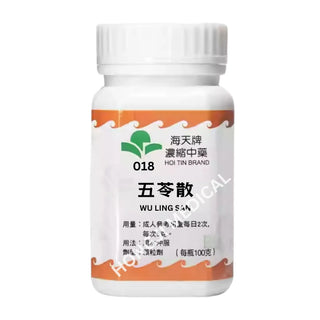
With ginseng, Atractylodes and licorice it forms Si Jun Zi Tang. With Polyporus, Alisma, Atractylodes and cinnamon twig it is Wu Ling San. Phlegm-fluid dizziness joins cinnamon twig, Atractylodes and licorice in Ling Gui Zhu Gan Tang. Heart-Spleen deficiency joins Astragalus, Angelica and sour-jujube seed in Gui Pi Tang. Name Fu Ling, the peel or Fu Shen.
How do you choose and store Fu Ling?
Choose heavy, firm pieces with a fine white fracture, few cracks, a faint odor and a bland taste; Yunnan material is highly regarded. The peel is dark-brown and wrinkled; Fu Shen shows pine root. Store dry, protected from damp and mold. Discard yellow, spongy, wormy or moldy lots. Buy labeled Fu Ling, Fu Ling Pi or Fu Shen, not Tu Fu Ling. Use official slices or food-grade sclerotium from a regulated source.

Medical Disclaimer — This article is provided for educational purposes only and describes traditional Chinese medicine concepts. It is not medical advice, and it is not intended to diagnose, treat, cure or prevent any disease. Always consult a qualified practitioner before using any herb, particularly if you are pregnant, nursing, taking medication or managing a diagnosed condition.

More Chinese Herbs

Login

Forgot your password?

Don't have an account yet?
Create account

Fu Ling (Poria): Drain Dampness, Strengthen the Spleen, and Calm the Heart