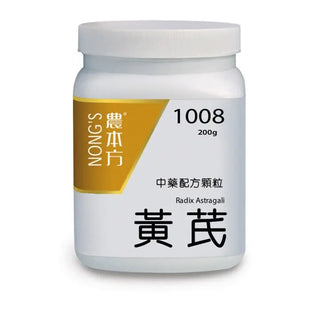
What is Huang Qi? Is it the same as Zhi Huang Qi, Hong Qi or Huang Qin?
Official Huang Qi (黄芪) is the dried root of Astragalus membranaceus var. mongholicus or A. membranaceus. The pharmacopoeial name is Astragali Radix. Zhi Huang Qi is the honey-fried form, leaning to boosting Qi and tonifying the middle. Hong Qi is the root of Hedysarum polybotrys, a separate monograph with similar but slightly weaker action. Huang Qin is Scutellaria root—bitter-cold and heat-clearing, a different drug. Write Huang Qi or Zhi Huang Qi; do not swap in Scutellaria, Codonopsis or anonymous “bei qi powder.”
What are the TCM properties and traditional uses of Huang Qi?
According to the Chinese Pharmacopoeia, Huang Qi is sweet and slightly warm, enters the Spleen and Lung channels, and acts to tonify Qi and raise Yang, secure the exterior and stop sweating, promote urination and reduce swelling, generate fluids and nourish Blood, move stagnation and unblock impediment, expel toxin and discharge pus, and close sores and generate flesh. It is used for Qi-deficient fatigue, poor appetite and loose stool, sinking middle Qi, chronic diarrhea and prolapse, bloody stool and flooding, exterior-deficiency spontaneous sweat, Qi-deficient edema, interior-heat wasting-thirst, Blood-deficient sallow complexion, hemiplegia, impediment numbness, sores that will not burst, and sores that will not close. Sweet-warm Qi tonic—suited to Spleen-Lung Qi lack, not to exterior excess, Yin-deficiency fire, or Qi stagnation with damp obstruction.
How do raw and honey-fried Huang Qi differ?
Raw Huang Qi leans to boosting Qi and securing the exterior, promoting urine and reducing swelling, and expelling toxin to generate flesh—exterior-deficiency sweat, Qi-deficient edema and sores that will not close favor it. Honey-fried Huang Qi is sweeter and warmer: dedicated to boosting Qi and tonifying the middle and to raising Yang from sinking—Qi-deficient fatigue, poor appetite with loose stool and sinking middle Qi favor it. The pharmacopoeia lists Zhi Huang Qi as “boosting Qi and tonifying the middle.” The script should name raw or fried; they are not interchangeable talk.
What is the usual dosage? Can it be steeped daily to tonify Qi?
The pharmacopoeial decoction dose is 9–30 g. Qi deficiency may use a short food-therapy course, not an unlimited four-season “astragalus water.” Exterior-attack fever, Yin-deficiency night sweat, epigastric fullness and a thick greasy coat stagnate further. Doses above 30 g need a practitioner—raising the amount on your own is not “more tonic.”
What are the contraindications? Can it be used in pregnancy?
Use caution or avoid in exterior excess, Qi stagnation with damp obstruction, food stagnation, Yin deficiency with Yang hyperactivity, and early sores still full of heat toxin. Sweet-warm can retain evil and assist heat. Pregnancy with Qi-deficient restless fetus may be treated in a formula, but it is not an unsupervised daily tonic. Disclose immunosuppressants. Stop if headache, flushed face, dry mouth, fullness or a new feverish cold appears.
Can Huang Qi tonify Qi, stop sweat, promote urination and lift sinking?
It can help. Exterior-deficiency spontaneous sweat and recurrent colds join Atractylodes and Saposhnikovia in Yu Ping Feng San. Sinking middle Qi with fatigue and poor appetite joins Angelica, Cimicifuga and Bupleurum in Bu Zhong Yi Qi Tang. Qi-deficient edema joins Stephania and Atractylodes in Fang Ji Huang Qi Tang. It tonifies Spleen-Lung Qi—not a specific for every fatigue, every edema or every prolapse. Acute febrile infection and heart or kidney failure need work-up first.
Can Huang Qi be drunk daily as an immunity, anti-cancer or blood-sugar tea?
Do not treat pharmacologic papers as a four-season wellness tea. Qi-deficient insecure exterior may be treated in a short course; an exterior attack, Yin-deficiency fire and damp-heat obstruction only grow more stuffed. “Astragalus against cancer and sugar” does not replace standard oncology or diabetes care. Commercial tea bags often mix jujube and sugar—people with diabetes should read the label. Tonifying Qi and raising Yang should name raw or honey-fried and a dose.
How do you choose among Huang Qi, Dang Shen, Ren Shen, Bai Zhu and Hong Qi?
Astragalus is sweet and slightly warm: especially good to tonify Qi and raise Yang, secure the exterior and promote urine; it also goes to the exterior to expel sores. Codonopsis is sweet-neutral: gentler to tonify middle Qi, generate fluid and nourish Blood. Ginseng is sweet and slightly warm: fiercely restores original Qi and secures collapse. Atractylodes is bitter-sweet-warm: fortifies the Spleen, dries damp, stops sweat and calms the fetus, leaning to the middle. Hong Qi is sweet-warm: similar to Astragalus but slightly weaker. Exterior-deficiency sweat and Qi-deficient edema favor Astragalus; simple Spleen deficiency favors Codonopsis and Atractylodes; collapse of original Qi favors ginseng. They may be paired; all are wrong as brute tonics when evil is excess and Qi is stagnant.
Which herbs is Huang Qi combined with? What are the representative formulas?
Exterior-deficiency spontaneous sweat joins Atractylodes and Saposhnikovia in Yu Ping Feng San. Sinking middle Qi joins Angelica, tangerine peel, Cimicifuga, Bupleurum, ginseng, Atractylodes and licorice in Bu Zhong Yi Qi Tang. Qi-deficient edema joins Stephania, Atractylodes and licorice in Fang Ji Huang Qi Tang. Write raw Huang Qi or Zhi Huang Qi; do not confuse it with Huang Qin or Hong Qi.
How do you choose and store Huang Qi?
Choose thick long roots, a yellow-white section with radial lines, ample powder, a sweet taste and a faint beany odor; slant-cut “mian qi” is highly regarded. Hollow rotten cores, bland taste, mold and insects are inferior. Honey-fried pieces smell of honey and darken. Store ventilated and dry, protected from damp and moths. Buy labeled Huang Qi or Zhi Huang Qi slices; do not replace them with dyed crumb powder or anonymous “bei qi extract.”