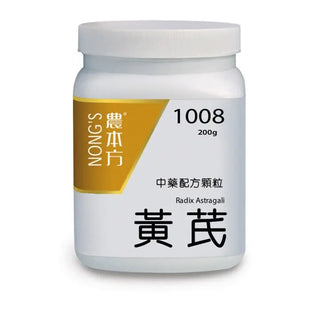
Roots and rhizomesTonifyingRadix Astragali

Huang Qi (Astragalus Root)

黃芪 · Huang Qi

Tonifying herb in Traditional Chinese Medicine. Traditional functions: Supplements qi, secures the exterior, promotes urination, outthrusts toxin, expels pus, closes sore, engenders flesh.

Read our in-depth guide

In-Depth GuideWant to learn more about Huang Qi?

Quick Facts

Latin NameRadix Astragali
Chinese Name & Pinyin黃芪 · Huang Qi
Medicinal PartRoots and rhizomes
Efficacy CategoryTonifying
Botanical OriginThe dried root of Astragalus membranaceus (Fisch.) Bge. var. mongholicus (Bge.) Hsiao or Astragalus membranaceus (Fisch.)(Fabaceae).
Nature & FlavourSweet; Warm
Channels EnteredSpleen, Lung

What Is Huang Qi?

Huang Qi (Astragalus Root) is a medicinal herb of Traditional Chinese Medicine.

Primarily produced in the Chinese provinces of Inner Mongolia, Shanxi, Hebei.

Nature & Flavour: Sweet; Warm
Channels Entered: Spleen, Lung

Huang Qi: Materia Medica Profile

Identification & Quality Standard

Radix Astragali

Botanical Origin

The dried root of Astragalus membranaceus (Fisch.) Bge. var. mongholicus (Bge.) Hsiao or Astragalus membranaceus (Fisch.)(Fabaceae).

Production Regions

Primarily produced in the Chinese provinces of Inner Mongolia, Shanxi, Hebei.

Quality Requirements

Superior medicinal material has thick and long root, obvious ‘chrysanthemum center’, small hollow, lack of broken skin; hong qi has red and moisture skin, even root, firm texture, and powdery.

Macroscopic Features

Straight root is cylindrical, some has branches, apex is relatively thick, 30~90cm long, 1~3.5cm diameter; externally longitudinally wrinkled, pale brownish-yellow or pale brown, with irregular longitudinal wrinkles or longitudinal grooves, hard, pliable and powdery; cortex is yellowish-white and relatively loose, xylem has chrysanthemum-like lines, bean-like flavor, slightly sweet taste. Old root center occasionally is rotten, black-brown or hollow. faint odor, slightly sweet taste, bean-like flavor when chewed.
Traditional TCM Properties

Sweet; WarmSpleenLung

Traditional Functions

Supplements qi, secures the exterior, promotes urination, outthrusts toxin, expels pus, closes sore, engenders flesh. Apply to deficiency of vital energy causing debilitation, anorexia and loose stools, collapse of middle-warmer energy, anal prolapse due to long term diarrhea, hemafecia, metrorrhagia and metrostaxis, continuous persipiration due to superficial deficiency, persistent superficial infection, persistent ulcers, wilting due to blood deficiency, internal heat dispersion-thirst.

How Huang Qi Is Used in TCM

In the Chinese materia medica, Huang Qi is classified among the Tonifying herbs. It appears in 18 classical formulas in our library.

Formulas containing Huang Qi are traditionally used for:

Abdominal PainFatigue & Low EnergySpontaneous SweatingPoor AppetiteLung Qi DeficiencyCold LimbsNumbness in LimbsJoint DiscomfortDiarrheaGeneral LethargySusceptible to ColdsSpleen Qi Deficiency

Classical Formulas Containing Huang Qi

+8 more

Frequently Asked Questions

What is Huang Qi? Is it the same as Zhi Huang Qi, Hong Qi or Huang Qin?
Official Huang Qi (黄芪) is the dried root of Astragalus membranaceus var. mongholicus or A. membranaceus. The pharmacopoeial name is Astragali Radix. Zhi Huang Qi is the honey-fried form, leaning to boosting Qi and tonifying the middle. Hong Qi is the root of Hedysarum polybotrys, a separate monograph with similar but slightly weaker action. Huang Qin is Scutellaria root—bitter-cold and heat-clearing, a different drug. Write Huang Qi or Zhi Huang Qi; do not swap in Scutellaria, Codonopsis or anonymous “bei qi powder.”
What are the TCM properties and traditional uses of Huang Qi?
According to the Chinese Pharmacopoeia, Huang Qi is sweet and slightly warm, enters the Spleen and Lung channels, and acts to tonify Qi and raise Yang, secure the exterior and stop sweating, promote urination and reduce swelling, generate fluids and nourish Blood, move stagnation and unblock impediment, expel toxin and discharge pus, and close sores and generate flesh. It is used for Qi-deficient fatigue, poor appetite and loose stool, sinking middle Qi, chronic diarrhea and prolapse, bloody stool and flooding, exterior-deficiency spontaneous sweat, Qi-deficient edema, interior-heat wasting-thirst, Blood-deficient sallow complexion, hemiplegia, impediment numbness, sores that will not burst, and sores that will not close. Sweet-warm Qi tonic—suited to Spleen-Lung Qi lack, not to exterior excess, Yin-deficiency fire, or Qi stagnation with damp obstruction.
How do raw and honey-fried Huang Qi differ?
Raw Huang Qi leans to boosting Qi and securing the exterior, promoting urine and reducing swelling, and expelling toxin to generate flesh—exterior-deficiency sweat, Qi-deficient edema and sores that will not close favor it. Honey-fried Huang Qi is sweeter and warmer: dedicated to boosting Qi and tonifying the middle and to raising Yang from sinking—Qi-deficient fatigue, poor appetite with loose stool and sinking middle Qi favor it. The pharmacopoeia lists Zhi Huang Qi as “boosting Qi and tonifying the middle.” The script should name raw or fried; they are not interchangeable talk.
Read the complete guide →

Learn More About Huang Qi

Explore our in-depth article covering the traditional uses, properties, functions, and TCM context of Huang Qi.

Read the Huang Qi Guide →

Medical Disclaimer — This article is provided for educational purposes only and describes traditional Chinese medicine concepts. It is not medical advice, and it is not intended to diagnose, treat, cure or prevent any disease. Always consult a qualified practitioner before using any herb, particularly if you are pregnant, nursing, taking medication or managing a diagnosed condition.

Login

Forgot your password?

Don't have an account yet?
Create account